

Text and images by Paul Comstock
In the May 1932 issue of Ye Sylvan Archer magazine appeared a hunting story by Forrest Nagler.
As I described earlier, Nagler was a co-author of the book Archery, the Technical Side. He was an intelligent guy with a down-to-earth real world approach grounded in reality.
It was Nagler who first wrote in 1933 about using an elliptical tiller to employ the advantages of a rectangular wooden-bow cross section. That idea allowed the new idea of flat bellies to be put to immediate use with the thousands of long, narrow bow staves sitting around in the United States. At that moment, they were pretty much the only kind of staves available.
Because of Nagler, flatbows quickly took off like wildfire in the 1930s, supplanting the round-belly English design.
Without such a development, the uncompromisingly technical articles of Clarence Hickman and Paul Klopsteg (the other Technical Side authors) might have been ignored for many more years.
Nagler’s 1932 hunting story is further evidence of his visionary thinking. He describes taking three wooden bows (two yew, one osage) on a trip to British Columbia, each 66 inches long and pulling 55 pounds.
He wrote about passing up a shot on a moose because he wasn’t sure he could hit a vital area. Days later he put two arrows into a treed black bear. The first hit was through the ribs, the second just above the heart. The bear died 16 seconds after the first arrow struck.
These details seem unremarkable in the 2020s. But they were revolutionary in 1932, because Nagler was determined to place his shots in the lungs. Accuracy, he knew, is more deadly than power alone.
At the time, others said an archer could hit a deer or bear just about anyplace, and kill it. Because of this concept, hunters were urged to use bows pulling at least 70 pounds, capable of shooting through bone for example.
Those ideas were hinted at by Saxton Pope’s Hunting With the Bow and Arrow of 1923. Pope wrote that a sharp broadhead would create internal bleeding so profuse that a deer or bear will quickly expire.
Some editions of the book had an extra chapter by Stewart Edward White that spelled the idea out more emphatically.
“If an arrow can be landed anywhere in the body it is certain and prompt death. This is not only true of the chest cavity, but of the belly. ... The arrow’s deadliness depends not on its shocking power, which of course is low, but upon internal hemorrhage,” White wrote.
White, in his defense, was pulling a bow drawing 82 pounds when he wrote that.
I might not be up on the latest attitudes, but when I started bowhunting in the early 1980s, “bowhunter education” was in vogue and White’s remarks would have been considered borderline criminal, even at 82 pounds draw weight.
In the 1980s (when many newly purchased broadheads were razor sharp) it was widely known that a gutshot deer’s death could be anything but “prompt.”
The issue, which Nagler clearly understood, is not whether an arrow will kill an animal. Instead, he knew that the issue is how quickly that death would occur. His bear that expired in 16 seconds was easy to find. That’s far from guaranteed with a bad hit. A bear or deer badly hit might live several days, making recovery a semi-nightmare for the most accomplished and determined trackers.
For my money, Nagler’s restraint in passing up the dubious shot on the moose makes him a worthy bowhunting hero.
As I will explain in a minute, White’s bad advice would remain widespread 20 years after he wrote it.
There weren’t many bowhunters in the early 1930s. In a Ye Sylvan Archer article in April 1932, Stanley Spencer (also described in a previous article) wrote that archery was “still struggling for existence,” with archers of all kinds numbered only in the thousands, compared to the millions participating in other sports.
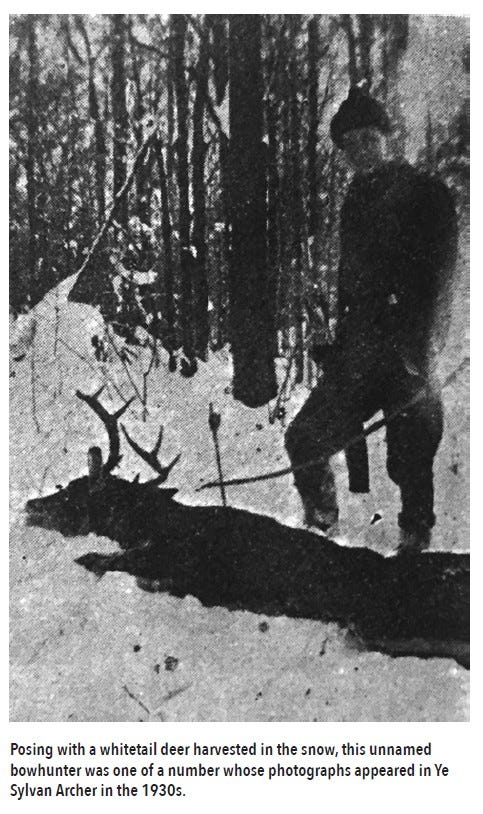
The good news at that time, however, is that talented bowhunters were out there, and evidence suggests they were just as experienced and savvy as Nagler.
In the same issue as Nagler’s story is one by Cassius Styles, a friend to both Saxton Pope and Art Young.
Styles wrote of his contemporaries who were using bows to take deer, bear, birds, cougar, wolverine and wildcats in 15 different states.
Styles pointed out some of those hunters were accomplished in National Archery Association competitions, which honed what Styles called “their deadly skill.”
This underscores a point I have made more than once here.
The novice - whether in 1932 or the 21st century - easily can assume an all-wood bow with a wide arrow pass is a friendly thing that will behave itself, remaining quite still and stable during a shot. Long ago, I thought the same thing. Fiberglass laminated bows with an arrow shelf behave, don’t they?
I was to learn what the slow motion movie cameras of Hickman and Klopsteg demonstrated in the 1940s: The all-wood bow with a wide arrow pass will vibrate and gyrate all over the place (at ultra high speed) in bad ways, unless we take steps to make them vibrate and gyrate in good ways.
That is the real problem and it’s a very big one. All of the shooting techniques used by the best NAA shooters were designed to solve that problem.
So it’s little wonder Cassius Style’s friends were effective hunters.
Taken as a group, the best NAA archers’ understanding about how to wring every last bit of accuracy out of an all-wood bow with a wide arrow pass, I am convinced, was unrivaled then and now.
Because of that skill, their accuracy was not limited to NAA targets set at fixed distances. In the 1930s, the National Field Archery Association was shooting at unmarked distances. Part of the thinking is that bowhunters must take their shots at unmarked distances.
The NAA’s best-ever shot at the Double York Round, Larry Hughes, was shooting with the National Field Archery Association by 1945, when the NFAA’s 1945-46 handbook named him as the third-best field shot in the U.S., based on that group’s competitions.
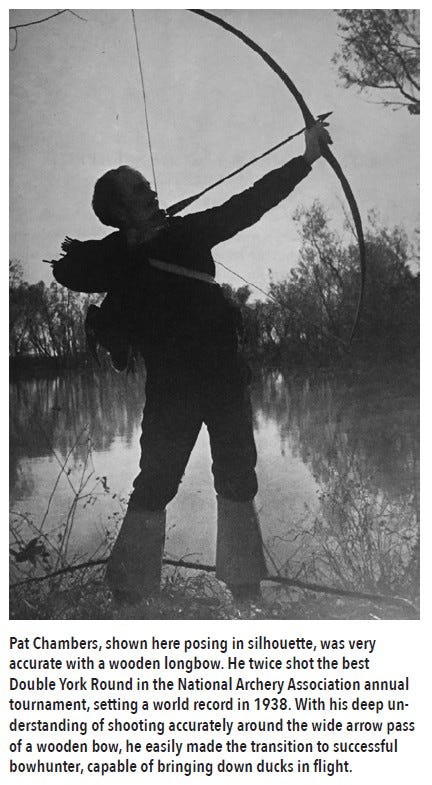
NAA national champion Pat Chambers (who set a world record in the Double York Round in 1938) was an accomplished hunter who could shoot ducks out of the air.
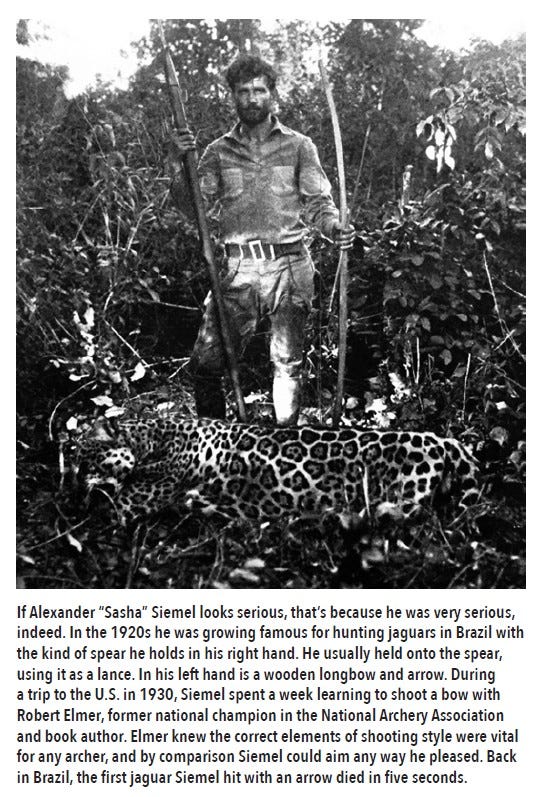
Alexander “Sasha” Siemel was famous for killing jaguars with a spear in Brazil (usually hand held, not thrown), years before some early bowhunters who are now legends had any publicity at all.
In 1930, Siemel spent a week with Robert Elmer (multiple NAA national champion and book author), learning to shoot a bow. Siemel chose his teacher wisely.
In the 1933 reprint of his book Archery, Elmer told how Siemel returned to Brazil with two bows, three bow staves and a large number of arrow shafts. The first jaguar he shot with an arrow died in five seconds.
Elmer described Stanley Spencer as a big game hunter, and told how Will “Chief” Compton - mentor to Pope and Young - and Spencer drove a car from California to Philadelphia to attend an NAA national tournament. The year was 1926, when such a road trip must have been quite the adventure.
THE LIMITS OF NAA INFLUENCE
It would have been a great thing if all the following archers and bowhunters understood the craft as well as Chambers, Spencer and Siemel.
Sadly, that did not happen for several reasons.
One is that most (if not all) of those who had a good understanding of NAA shooting science were NAA members or knew NAA members and shot with them. Those without such benefits were not so well informed.
The second is that no single book of that (or any) time contained what I would call a comprehensive catalog of shooting techniques used by NAA archers. (For that reason, it took me years to thoroughly understand everything I described in my last article here. And that article couldn’t include absolutely everything.)
It’s true that Robert Elmer gave it a shot in his books. But Elmer gave only a couple of brief and vague references to Chester Seay and Stanley Spencer, the main original proponents of the so-called “relaxed” shooting, described in an earlier article. By 1941, their influence had surpassed Elmer’s, at least in print. After about 1935, a host of lesser archery books offered diluted (usually badly diluted) versions of what Seay and Spencer said, not Elmer.
This was the result: Let’s say we were taking up archery by the mid-1930s, and we knew nothing about the NAA, and had not read Seay, Spencer or Elmer. This meant that we were going to have to figure out a lot of things by ourselves. We might make a lot of wrong guesses, and quickly run out of ideas about how to improve.
If we wanted to be as deadly with a bow as Forrest Nagler and Sasha Siemel, we faced a serious uphill fight. Maybe an impossible fight.
I believe some of the NAA’s lessons have survived to a degree into the 21st century, but I fear it’s a small degree in terms of numbers and influence. That they survived at all might be because determined and intelligent individuals worked hard to reach the best conclusions independently. Or maybe they survived as a sort of oral tradition, passed on to younger archers over the years. Another issue is that the NAA was an environment that demanded serious commitment.
Consider a national tournament. Even getting to one was a challenge. Spencer and Compton drove about 3,000 miles to do it in 1926.
The competition was physically exhausting, nerve-wracking and time-consuming. A Double York Round was 288 arrows - 144 shot at 100 yards, 96 at 80 yards, and 48 at 60 yards. Men also shot a Double American Round - 60 arrows each at 60, 50 and 40 yards.
That’s 468 arrows per man. They shot an “end” of six arrows at a time. That’s 78 ends per man. For each 10 guys shooting, it was 780 ends. Add in the time traipsing back and forth, writing everything down, deciding which color an arrow hit, picking up all the misses, etc.
A four-foot target was used at all ranges. Its total diameter was composed of equal distances of its five colors: gold, red, blue, black and white, listed from center to edge. The point values were 9, 7, 5, 3 and 1, respectively.
Of course, women also competed. For most of the NAA’s history, they shot double Columbia and National rounds. Ranges were out to 60 yards, totaling 288 arrows.
Attending an NAA national tournament required an enormous amount of motivation, to put it mildly.
Archers probably wanted to be there because the national tournament had enormous prestige and influence among those paying attention. Of the 4,212 mathematically potential points in the combined double York and American, only a handful of points might separate the champion from second place when it was all over.
No one knew it at the time, but the Japanese attack on Pearl Harbor in 1941 marked the beginning of the end for the old NAA. The tournaments stopped during the war, when gasoline was rationed and public transportation was crowded.
For reasons not entirely clear, the NAA never held another national tournament after the war. Elmer only wrote that it was decided to instead conduct mail matches - with archers shooting close to home and swapping the results by letter. Things would never be the same again.
WHAT SAXTON POPE SAID
Even if a 1930s book had effectively described the shooting methods used by the best of the NAA, all evidence suggests its advice would have had limited effect. It would have been mostly ignored, in other words.
I base that conclusion on the fact that some basic advice in Pope’s Hunting With the Bow and Arrow was completely ignored by thousands, at least by the mid-1930s.
So much so, that I have wondered how many archers in the 1930s actually read it. For that matter, how many have read it now?
I have at least 100 Facebook friends who are archers, and I posted a survey: Who has read Hunting With the Bow and Arrow? Probably not everyone saw that post, but among those who did 16 said they read it. (The book is online, by the way. Keep reading for the link.)
Pope has a chapter on how to shoot. He spends paragraphs discussing the issues the NAA wrestled with: How to position the body, how to hold the bow and string, and what movements to make that result in an accurate shot.
He also included this paragraph: “The method of aiming in game shooting consists in fixing binocular vision on the object to be hit, drawing the nock of the arrow beneath the right eye and observing that the head of the arrow is in a direct line with the mark by the indirect vision of the right eye. Both eyes are open, both see the mark, but only the right observes the arrowhead, the left ignores it. Your vision must be so concentrated upon one point that all else fades from view. Just two things exist - your mark and your arrowhead.”
Maybe it’s just me, but I found that paragraph easy to understand and thought it made perfect sense the minute I read it.
Elsewhere in his book, Pope suggests that once we are an accomplished shot, we only need to see the dim outline of the mark in near total darkness to hit it.
That sentence stuck in my mind, because twice I’ve shot arrows into raccoons in trees when I could see practically nothing but their outline against a starry sky. So yeah, I agree with the man.
In the April 1932 issue of Ye Sylvan Archer, Cassius Styles made a similar point. He wrote that coordination and a good release were vital, and the method of aiming was quite secondary by comparison for an accurate shot.
Both men’s observations are consistent with what Roger Ascham wrote in Toxophilus in 1545: Gazing intently at the mark is critical to hitting it; to accomplish it, every part of the body will obey what the eye commands.
AN UNKNOWN MARKETING GENIUS
Some time around 1934 or not long after, there appeared one of the greatest marketing and advertising geniuses in modern history. I have never been able to identify this individual in the historical record. But whoever he was (assuming he was a man), he was a visionary the likes of which is rarely seen.
Had his message been spiritual, he would have been hailed as a prophet. Had he worked for Ford, he might have put General Motors out of business. That’s how good this guy was.
He coined the term “instinctive shooting.”
This was irresistible new packaging for an ancient concept.
I have the Ye Sylvan Archer issues from January 1932 to October 1933, and I can’t find the word “instinctive” in any of them.
Pope, Ascham and Maurice Thompson (author of The Witchery of Archery and now recognized as a godfather of “instinctive shooting”) never used the word either, that I can find.
But once it appeared, it was touted heavily in archery magazines, to the near total exclusion of any other aiming method for hunters. It was as if Saxton Pope had never described his standard aiming method.
If the phrase “instinctive shooting” meant nothing except aiming without using the arrow for reference, it wouldn’t take too long to describe its history.
Instead, published articles of the 1930s and 1940s show that from the onset, the term was infused with far more meaning, as if it was a panacea.
Previously, descriptions of shooting technique seemed to rely mostly on cold, straightforward language to describe details and conclusions. They implied that virtually everything can be quantified.
Those early articles on instinctive shooting were far more emotional, with paragraphs flooded by superlatives and delivered with fervor, often heaping scorn on any conflicting ideas.
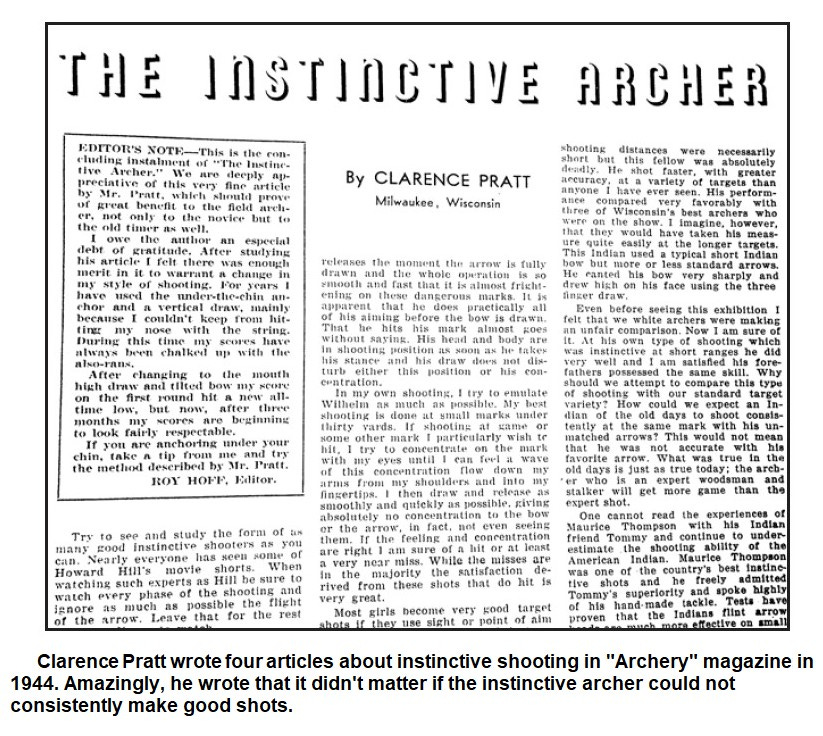
Of the examples of this that I have found, none is quite as fascinating as one written by Clarence Pratt.
A genuine treatise, it appeared in four issues of Archery magazine, from May to August 1944. It covered roughly 172 column inches and contained about 11,000 words.
THE TALKING POINTS
Mr. Pratt was a true believer, needless to say. His article made a number of talking points that were solidly welded to the instinctive idea in other articles at that time by adherents of the term.
Like many instinctive-advocating writers, Pratt attacked the point-of-aim system used by NAA archers to shoot out to 199 yards, and bow sights. His first page was devoted to these topics.
It can only be concluded that Pratt and similar writers had no idea what Pope wrote. If they did, they would have known another option had existed for decades. What Pope described, by the way, was not point-of-aim.
This is the first time I have mentioned point-of-aim in these articles. It was a system first used in England at the long ranges of the York Round. (100 yards, remember, is way the heck out there.) It also was used at fixed distances (meaning the archer always knew how far away the target was) in NAA competitions. And the NAA archers used that name, “point-of-aim.”
It worked like this: At short range, archers directly lined up the arrow tip with some feature on the ground in front of the target. (Because at short range NAA archers would hold under the target.) The goal was to achieve precisely consistent elevation. Often they would place something on the ground to provide a reference. At long range - and the long ranges were 80 and 100 yards - NAA archers had to line up the arrow tip well above the target. They picked a point of aim by observing something directly over the target in their field of view. This requires something tall enough in the background.
Half the game was figuring out where these points of aims should be, particularly when shooting in a new location for the first time. If their estimates were off, they weren’t going to hit the target’s gold center.
Pratt argued that a novice trained with point-of-aim would be helpless when they didn’t know how many yards away their mark was.
Bow sights of the era (as sold commercially) had a single pin. Pratt said those dependent on a sight also were helpless without it.
At moving targets, he wrote, point of aim is out of the question and a bow sight is a hindrance.
Pratt talked about shooting bullfrogs and snakes, and other anecdotes - plus the great pleasure of a successful shot. He described how the instinctive moves of champion bowlers, high divers and golfers are an analogy to instinctive shooting.
He offered practical advice on equipment, described a bowfishing rig and devoted a page to shooting form. The archer must practice, he said, and learn how to concentrate his vision on a tiny spot.
This is all fine and dandy stuff. Probably all the novices Pratt met were left stupefied and bewildered by bow sights and point-of-aim.
So, was Pratt a good shot?
MISSING? NO PROBLEM!
Most of his shots were misses, he wrote.
He also wasn’t interested in trying to shoot a deer through both lungs. “Most of us have trouble even hitting a deer, let alone a tiny spot on it,” he said.
“I am too lazy to hold a strong bow for the length of time necessary to do good shooting with either sight or point-of-aim,” he added.
He also wrote, “Your instinctive archer goes into the field with the feeling that he has the potential ability to make certain good shots. That he could not consistently make them worries him not at all.”
OK, Clarence, that’s great for our self-esteem, but what if the deer ends up gutshot? And we can never find it?
This is the stuff that was selling like hotcakes in 1944. Everybody was gobbling it up. Why? If the answer is that it tacitly promises some kind of success without the nuisance of having to learn a difficult skill (in that era, it pretty much did) that underscores the genius of whoever started using the term in the first place.
I am sure some instinctive adherents at the time honed their shooting elements by trial and error, and were accurate.
Yet Pratt was the guy writing a four-part series. We have to give him credit for at least being honest about his results.
It must be stressed that the appearance of fiberglass laminated center-shot bows would help remedy a number of shooting issues, eventually.
Compared to all-wood bows with a wide arrow pass - which was the only type available in the U.S. Before 1941, at least - modern bows that are center-shot (or at least have an arrow shelf) are considerably easier in terms of accuracy and their higher tolerance for varied shooting techniques.
It’s also true that the future dominance of multiple sight pins would speak to the fact that plenty of people are unhappy if they can’t make good shots consistently. But back to 1944.
Pratt said as a beginner he had “no competent instruction.” That’s a tough situation for anybody to be in, so the guy was doing his best.
All of this suggests practically everybody had quit reading Saxton Pope’s book long before 1944.
Pratt also wrote that shooting form is “always secondary” for target shooting, proving he had no clue how NAA archers really developed accuracy.
When I said in the last article that the NAA had “shooting secrets,” they certainly were secrets to large numbers of people by 1944.
MORE PEOPLE TO ARCHERY
There is a backstory to all this - when the National Field Archery Association got its start in 1934.
One-time NFAA secretary John L. Yount in 1974 wrote a history of the group’s origins, which I found online.
Yount made it plain that it didn’t matter if “instinctive” archers couldn’t hit anything. What mattered was drawing more people to archery.
In the early 1930s - when the only organized archery was target shooting - Yount said many clubs held annual field shoots that were mostly at novelty targets. This was a fun thing to do, he wrote. The shoots “could almost be termed comic relief,” he added.
Such a permanent course was opened in 1934 at Redlands, California. Its 20 targets were at unmarked ranges. Yount wrote that one 160-yard shot had to be made over a ravine that he said was “still full of arrows 20 years later.”
Eventually the idea spread across the country.
A goal, Yount wrote, was “to promote a shooting style, instinctive” that would “greatly increase the number of archers.”
The number of archers certainly did increase. Whoever coined the term instinctive probably was connected with the start of the NFAA.
By the time the NFAA officially organized, it was staging shooting competitions and became an organized haven for bowhunters. The group printed handbooks every couple of years with multiple hunting-related articles. It took over publication of Ye Sylvan Archer magazine and replaced it eventually with Archery magazine, which lasted until at least the late 1960s.
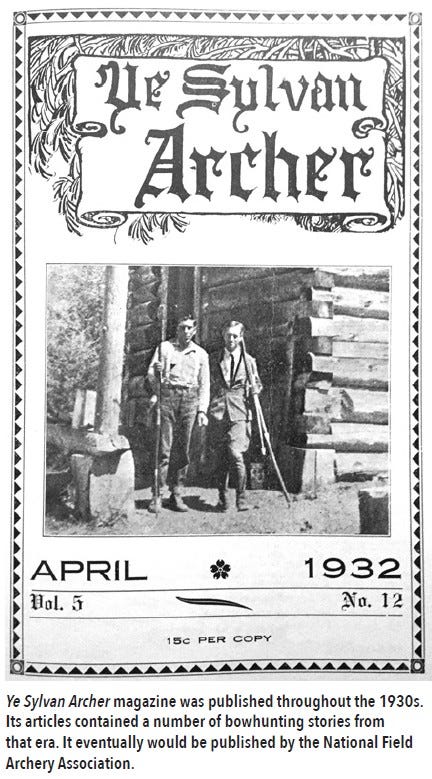
Yount also wrote an article on instinctive shooting for the NFAA’s 1945-46 handbook. He gave point-of-aim and bow sights as good a beating as Pratt did. It was this article that named Larry Hughes as the nation’s third-best field shot at the time.
Yet our old buddy Forrest Nagler wrote a short article on using a bow sight in the same handbook. Remember the hunting article Nagler wrote in 1932? Nagler had a screw fixed to his bow he used as a 25-yard sight. The bear was a bit farther away than 25 yards, so Nagler held over slightly. So much for being confused by a bow sight.
In the early ‘80s I knew a guy who had only one sight pin on his fiberglass centershot recurve. He said he held under if the deer was close and could hold over on a long shot. The pin was set at 20 yards, as I recall. Several other older guys had two or three sight pins on their recurves and did fine. At the time, we all made it a point to know how far away 20 yards was, and wanted the deer at least that close and closer was better. So we could place our shots.
THINGS HAVE CHANGED
Other things have changed since 1944. Despite its highly emotional beginnings, the NFAA is now a genuine target shooting organization, with classes for compounds, sights and releases. Since full center-shot bow risers became common in the mid to late 1950s, consistency is easier for recurve shooters - instinctive or otherwise - reducing the liabilities that plagued Clarence Pratt. Deep arrow shelves at the arrow pass for glass-laminated longbows provide much the same advantage.
The use of early fiberglass backings and facings (the stuff on the belly side) began to appear after World War II, and unidirectional fiberglass (still used today) was widespread by the early 1950s. It let working recurves - whose value was demonstrated in the 1940s by a guy named Russell Wilcox; Elmer tells the story in his 1946 book Target Archery - be easy to manufacture and reliable.
Round-wheel compound bows became widely available in the early 1970s, and compounds with oblong cams (which shot faster) grew popular about 10 years later.
In the 1980s, the fastest compound bows shot about 200 feet per second. The best compound shot I knew back then (he won a state championship) wanted a deer to be 12 yards away when he shot at it. Wooden-bow range, in other words.
Today, I read that at least one compound bow model can shoot 370 fps. I hear some compound bow shooters on YouTube saying they will shoot at a deer 50 yards away, if not farther.
Let those who love that stuff sing its praises.
If I ever find a genie’s lamp, I’ll wish to go on a 1932 hunt with Forrest Nagler and Cassius Styles. We’d even invite Clarence Pratt to join us.
---
Hunting With the Bow and Arrow and other vintage archery books (with expired copyright) can be read online at www.archerylibrary.com.
Paul Comstock is the author of The Bent Stick: Making and Using Wooden Hunting Bows and a co-author of The Traditional Bowyer’s Bibles, Volumes 1–4. He also wrote the Foreword to Quiver: The Art of Life through Bowcraft.