


The following passage and select photos are directly from the book Quiver: The Art of Life through Bowcraft, which can be purchased at www.projectquiver.com.
In a loft in a centuries-old barn on the edge of the Bay of Fundy in Sackville, New Brunswick, lay dozens of carved ash poles. To the untrained eye, they might appear to be spears, as tall as a man, with perfectly sized midsections for a hand grip, and pointed tips. But, in fact, they are longbows, or more accurately, longbow staves, as they have not yet been fully formed into bows. The pointed ends are lacking horn or hardwood nocks, which would be perfectly drilled out to fit the pointed tips, so that when sanded, they would appear to be growing out of the bow rather than something added to it.
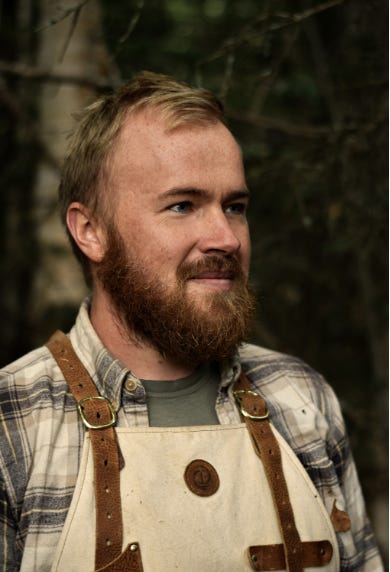
Adding nocks would be the next logical step in converting these ash staves into English longbows. But most, if not all, will never receive nocks. Master bowyer Jake Fenwick, who carved them to this stage, has decided that they will most likely not make superior longbows, a necessary criteria of Jake’s brand, Fenwick Bows. Their lack of promotion out of “stavedom” is not because there is anything obviously wrong with them. In fact, they are quite beautiful, but, for various reasons, Jake senses that they will not survive as high-quality bows for at least a decade, his minimal threshold to produce a bow for a customer.
Directly adjacent to the barn, and sharing a wall, is the house of Jake, his wife Jill, and their three-year-old son, Silas. The two-level house was built in 1790 of primarily red spruce timber, which still serves as the main structure of the house today, including floors worn marble-smooth with undulations from centuries of foot traffic. When built, the walls were insulated with horse hair and glass bottles, all protected by a birch bark vapor barrier. Cedar shakes on the exterior of the house have kept the Atlantic Coast elements at bay through countless storms.
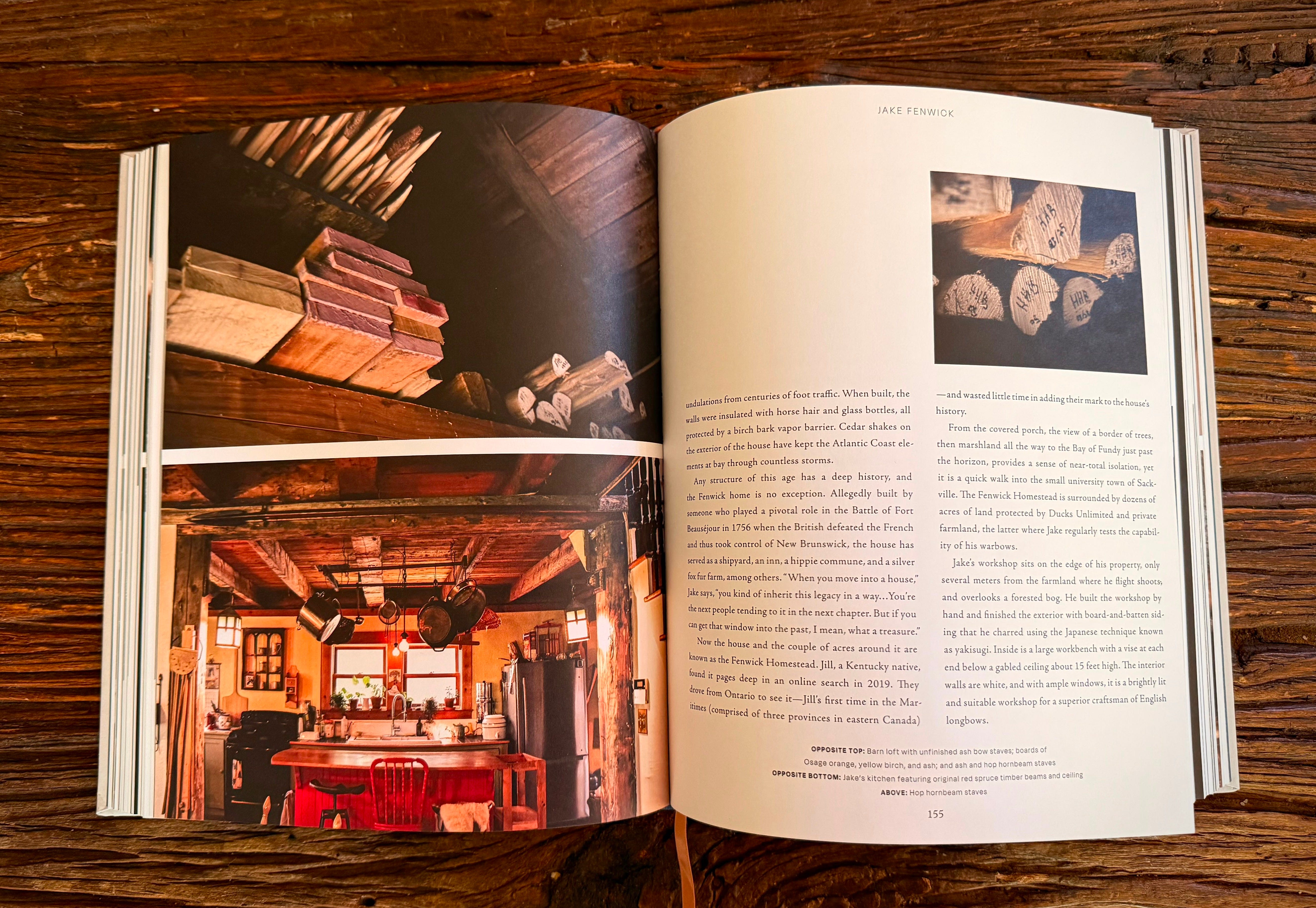
Any structure of this age has a deep history, and the Fenwick home is no exception. Allegedly built by someone who played a pivotal role in the Battle of Fort Béausajour in 1756 when the British defeated the French and thus took control of New Brunswick, the house has served as a shipyard, an inn, a hippy commune, and a silver fox fur farm, among others. “When you move into a house,” Jake says, “you kind of inherit this legacy in a way…You’re the next people tending to it in the next chapter. But if you can get that window into the past, I mean, what a treasure.”
Now the house and the couple of acres around it are known as the Fenwick Homestead. Jill, a Kentucky native, found it pages deep in an online search in 2019. They drove from Ontario to see it - Jill’s first time in the Maritimes (comprised of three provinces in eastern Canada) - and wasted little time in adding their mark to the house’s history.
From the covered porch, the view of a border of trees, then marshland all the way to the Bay of Fundy just past the horizon, provides a sense of near-total isolation, yet it is a quick walk into the small university town of Sackville. The Fenwick Homestead is surrounded by dozens of acres of land protected by Ducks Unlimited and private farmland, the latter where Jake regularly tests the capability of his warbows.
Jake’s workshop sits on the edge of his property, only several meters from the farmland where he flight shoots, and overlooks a forested bog. He built the workshop by hand and finished the exterior with board-and-batten siding that he charred using the Japanese technique known as yakisugi. Inside is a large workbench with a vice at each end below a gabled ceiling about 15 feet high. The interior walls are white, and with ample windows, it is a brightly lit and suitable workshop for a superior craftsman of English longbows.
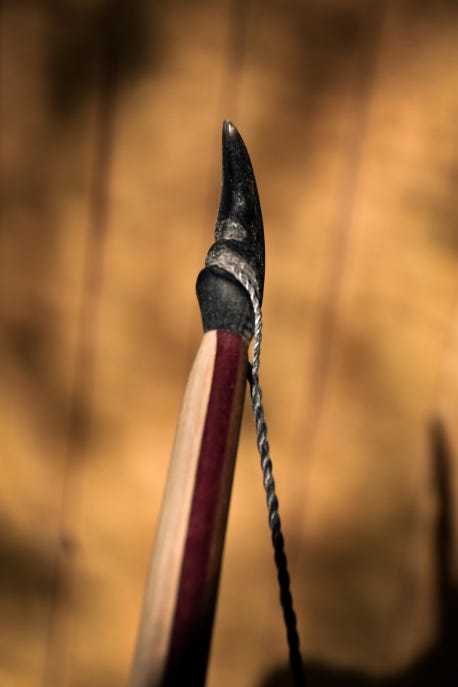
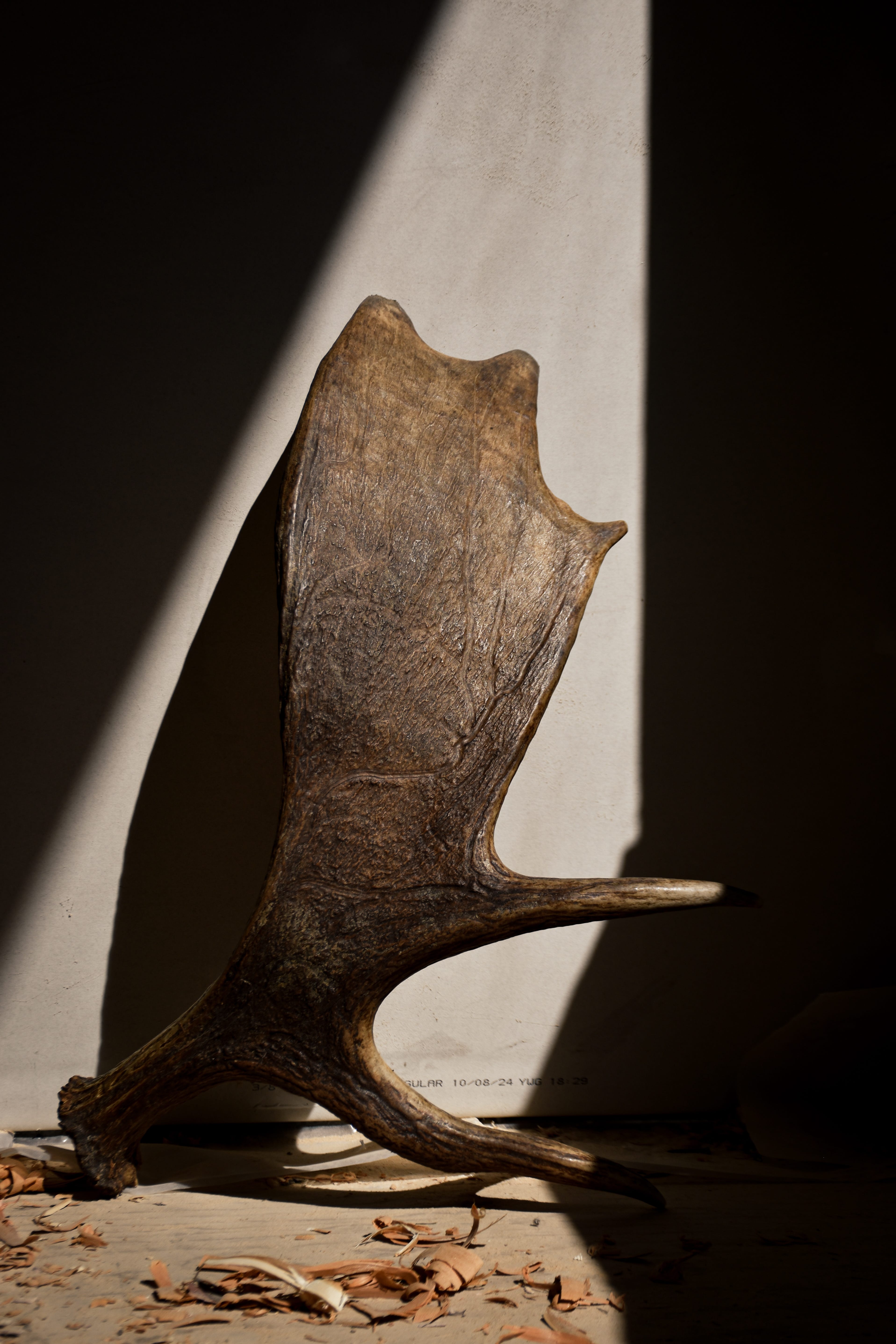
Jake carves all of his bows while standing, primarily using hand tools, as well as a bandsaw to remove mass from staves. His preferred hand tools include a small hand plane, rasps, card scrapers, and a draw knife, an antique that has been passed down through generations. He also uses a stone grinder to partially shape his bow tips and nocks. His trademark nocks–bowyers often have their own unique style–are generally made from cow horn, but Jake is happy to use local moose antler nocks, blending his maritime home with English tradition.
On one wall of his workshop is his tillering tree with a multi-pulley setup. Many of the longbows that Jake carves are warbows–longbows that require more than 80 pounds to draw. Tillering bows that pull more than 120 pounds as finished bows is onerous with only a single pulley. It is important for Jake to get the tiller perfect as early as possible so he can test the staves to full weight before removing too much mass. One thin spot, known as a hinge, can result in a finished bow being well under target weight.
Bow carving did not come to Jake as a directly generational craft, although some of his ancestors were possibly bowyers, or at least archers. Jake’s journey began when he was 13 and researched his family’s history. Archery comes up very quickly in his mother’s lineage as her maiden name is Archer. Jake’s great uncle, Dr. John H. Archer, was the president of the University of Regina in Saskatchewan, Canada. During Dr. Archer’s tenure a student in the history department did a research project on him, tracing his ancestry back to 1038. The student uncovered numerous connections to archery, which enthralled Jake.
According to Jake, a self-proclaimed nerdy kid and history buff, “It didn’t take much research to realize the bows that they would have been using were the English longbows, the English warbows.” And so he continued his research by diving into YouTube, which was still relatively new at the time. He could only find one guy who was really posting about archery, and his name was Nick Birmingham, whom Jake would eventually meet. Jake became captivated by one video of Nick shooting an English warbow. “It looked like the crescent moon. Everything was in balance. It was like this beautiful mix of power and art, and I was fascinated by it!”
And Jake’s fascination only grew. His dad knew a neighbor who was into mounted archery, or archery from horseback. Jake started spending time with him, absorbing as much knowledge as possible. Eventually he took Jake to the Eastern Traditional Archery Rendezvous, or ETAR, in Pennsylvania, which is considered the world’s largest gathering of traditional archery. It was there Jake met his future lifelong mentor and friend, Gerry Lee. Gerry was a fletcher, bear trapper, and standup comedian, and most influentially to Jake, he was obsessed with English archery. In Gerry, Jake had a direct connection to English longbows, and Gerry played a significant role in his future as a bowyer.
It was not hard for Jake to imagine life as a craftsman. His father, Graeme, is a lifelong Shaker furniture maker, and although that craft did not appeal to Jake as a teenager, working with his hands and wood certainly did. School never excited him, and with his newfound passion for bowmaking, he daydreamed about bows while in the classroom and stayed up late at night studying bows and carving them. He says now of finding bow carving as a teen, “It was actually a lifesaver for me. It gave me something to focus on, to really build on.”
At 16, Jake started his bow-making business. He wasn’t earning a lot of money, but as a kid living in his parents’ house with no expenses, the ability to earn and save money doing what he loved excited him. He regularly engaged in online chats and forums with other bowyers, especially those in the United Kingdom. As with many bowyers, the Primitive Archer Forum was valuable, but for Jake, finding the English Warbow Society was like striking gold. Jake was so inspired by it that he, Gerry Lee, and Karl Malmstrom eventually started a Canadian chapter.
With Jake’s unlimited enthusiasm, he continued to create opportunities. Within a year of starting his business, bowyer Ian Sturgess of Boston Bows in the UK came to Canada, and Jake jumped at the opportunity to learn from him. They carved many bows together, and eventually Jake went to the UK and worked in his shop for a while. This was a watershed period for Jake when he realized he could create his own post-secondary education by traveling the world studying with bowyers.
Instead of going to college, Jake spent the next six years seeing the world, carving a path around the globe based on the locations of bowyers. Sometimes he met with a bowyer just for a shoot while passing through. With others, he spent days and weeks working alongside them in their workshops. His passion grew with every bow he carved. “To my knowledge, it’s the only form of woodworking that requires such movement of its subject,” romanticizes Jake. “You’re just…alone in your shop or in your yard, wherever you are. And the whole craziness of the world…can float off over there somewhere.”
Jake’s tales of adventures are rich and far-flung, from places such as Jordan, Iceland, South Africa, New Zealand, and many more. He would travel to many places with a quiver of bows to sell, and when the bows were gone and the money used up, he either went back to his family home to make more bows, or he knocked on doors seeking interesting work. He learned to make leather shoes with an old woman in Greece, worked on an olive farm, lived with Bedouins, and learned the art of timber framing.
In Italy, he met with a bow carving legend who used to be the only person the Italian government allowed to harvest and sell yew. In New Zealand and Australia, where there is no native tradition of bow making, Jake seized the commercial opportunity to sell his bows. He remembers “smuggling” 25 to 30 longbows into New Zealand. There, while selling his bows, he worked with both expert and fledgling bowyers and experimented with local woods, some of which were incredibly dense and unusual for bow making.
His explorations awarded him more than just skills and knowledge. On a trip to Iceland at 21 years of age, Jake met his future wife, Jill, at a hostel in Reykjavik. They rented a car with other travelers and set out to explore the country. Traveling was exciting but not easy, and eventually they were forced to abandon the car in the middle of an icy cold river that the car couldn’t cross. They took their belongings and forded the river to safety. Soaking wet, they luckily found an abandoned building where they holed up for a couple nights until they were able to hitchhike back to civilization with some Russians. This might seem a horrific experience to some, but to Jake, it has stood as just another of life’s grand adventures.
Getting by on the road came easily to Jake. A consummate joker filled with a joy for life, he makes friends easily wherever he goes. He has a vast mental catalog of movie lines and easily slips them into conversations for comic relief, always with a character-accurate accent. He is a master of accents and deploys them at will to enrich or lighten a story. This ability contributes in no small part to Jake’s storytelling. He is a vivid and lively storyteller, generously sharing his rich experiences as a traveler, bowyer, and family man.
Since Jake decided to create his own schooling through global travels, and because he paid for those mostly through the earnings of his young bow company, in 2019, Jake and Jill invested his “college” money and her savings into real estate. They purchased not only the Bay of Fundy farmhouse but also a trapper’s cabin in a maple forest in Nova Scotia. The cabin serves as a remote getaway where Jake taps the maple trees to collect the sap and make maple syrup. The forest in the area is littered with abandoned sugar shacks and the town, named Fenwick - coincidence or no - is the maple tapping hub of the region.
It was inside his Nova Scotia trapper’s cabin where Jake found a carved face of the “Green Man.” Through his mentor Gerry Lee, Jake already had a connection to the lore of the Green Man, an enduring figure in European folklore who often overlaps with the archery icon Robin Hood and the Green Knight of Arthurian legend. It is said that these three figures often straddle worlds: half wild, half human, forest bound. The Green Man represents rebirth, changing of the seasons, and the life force of the forest. To Jake, the Green Man also serves as a tie to his mentor. The carved face now hangs above the doorway of the Fenwick Bows workshop.
The forest is a comfortable home for Jake. He spent much of his youth on the Bruce Peninsula of Lake Huron, Ontario, in a family cabin on the Niagara Escarpment. There the white cedar trees are more than a thousand years old, and there was a glut of potential bow wood. In his early years as a bowyer, he harvested elm, ash, ironwood, black walnut, and others.
Although Jake has only lived in the Maritimes for several years, he feels a strong connection to the weather-worn coast. The region where he lives along the Bay of Fundy is known as Wabanakia, meaning the Land of Dawn. Here the sun rises first on the continent of North America. The First Nations people from the region are the Wabanaki, People of Dawn.
The biggest enemy of the Wabanaki, which included five tribes, was the British. In the 17th Century, the tribes of the Wabanaki suffered greatly from battle, pestilence, geographical displacement, and cultural purging. Ironically, the English longbow would have likely played a role in their hardship, but the Wabanakis were not strangers to the bow and arrow.
In the Wabanaki creation myth, the main character and hero is known as Glooscap the Transformer, who was created from dust. His grandmother was Woodchuck, and in part from her tutelage, he became a capable hunter, fisherman, and canoe maker. It is said that he once greedily snared all of the earth’s animals to provide for his grandmother, but she was not pleased with his lack of regard for the rest of humanity. And thus he released the animals to again roam the earth. When Glooscap vanished, he left instructions to the Wabanaki that included knowledge of the lance, knife, and bow and arrow, tools that they would use to hunt the animals he had released.
On the Fenwick Homestead, dawn spreads its nimble fingers as it emerges over the Bay of Fundy, touching the marsh lands and railroad tracks that separate the Homestead from the Bay. Jake loves this place and the sanctuary it provides for him to be immersed in his craft of carving warbows and seeing how far they can fling his arrows. “The romance of it is going out into a field or a forest…the sun’s hitting the grass, there’s a nice breeze…It’s just you and something you’ve made - stick, string, arrow - and you shoot.”
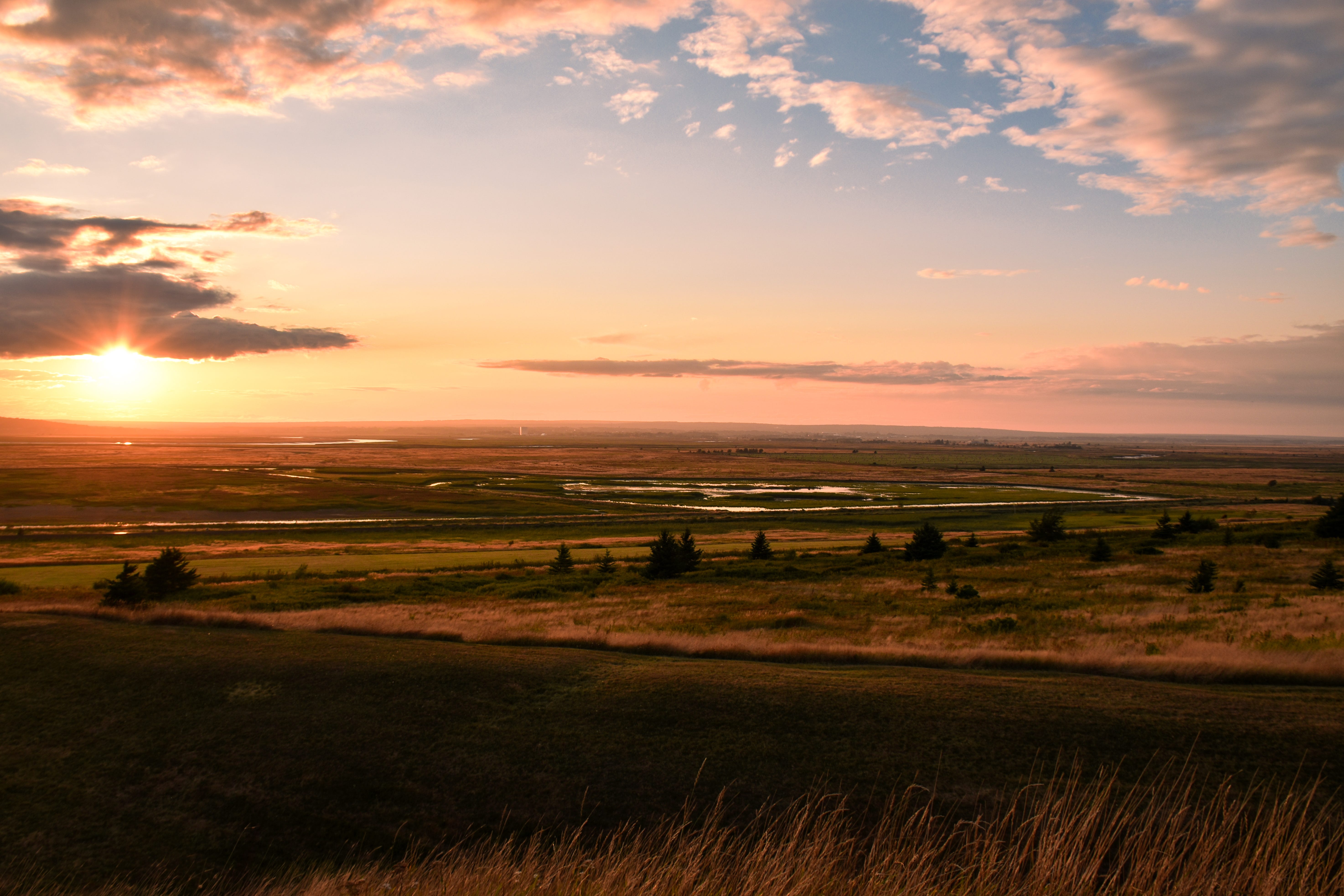
The marshlands adjacent to his home are part of the saltwater tidal marsh known as Tantramar Marsh, or in Acadian French, Tintamarre, which means “din” or “racket” in reference to the many birds that migrate through and feed in the marshes. The marsh is a birdwatcher’s paradise, and one birdwatcher who is very pleased with Jake’s home is his mother, Deanna, a photographer and graphic designer. With an outgoing and jubilant personality, it is not hard to imagine where Jake gets his enthusiasm and sense of humor. Deanna recently moved to the Maritimes from Ontario to be closer to her only son’s young family. Deanna is not only enormously happy to care for Silas, her only grandson, at any opportunity, but she is also completely supportive of Jake’s lifestyle and career choice. Their bond is admirable, and, as Jake quips, when they are alone, they are like two old ladies enthralled in banter and gossip.
Jake is extremely appreciative of his relationship with his parents. They have always been very supportive of his unorthodox choices. In being able to pursue his interests, he says he was able to build inner resilience and gain confidence, virtues that he sees lacking in today’s youth. “In the past, kids always had a purpose.” Today he sees them being held back by “limiting things told to them by their parents…and also their own confidence. And so if you can build that confidence,” he continues,” and follow what you’re interested in…you’ll have that resilience.” Now, as a father and husband, Jake intends to foster inner resilience and purpose in his son and to support him in whatever his interests might be. Silas is a lucky boy: perhaps there is no better example of a resilient individual carving a unique and purposeful path in life than Jake Fenwick.
Buy the book Quiver: The Art of Life through Bowcraft at projectquiver.com.