


For those of you who do not know me, I will begin with an introduction. My name is Todd N. Howard, and in the world of traditional archery, I am mostly known for the book - Quiver: The Art of Life through Bowcraft - that I co-wrote with my teenage daughter, Ela Harper.
The N. is not important but it is to distinguish me from another Todd Howard who is a famous video game creator, allegedly residing in Maryland, which is my birth state. Otherwise, we are unlikely to be confused: I am the least likely person I know to even play a video game, let alone create one. My other famous namesake is the wolf from Teen Wolf Too, played by Jason Bateman, not to be confused with the character’s cousin Scott Howard who was played by Michael J. Fox in the original Teen Wolf. In case you are wondering, neither of these famous wolves served as an inspiration for Salish Wolf.
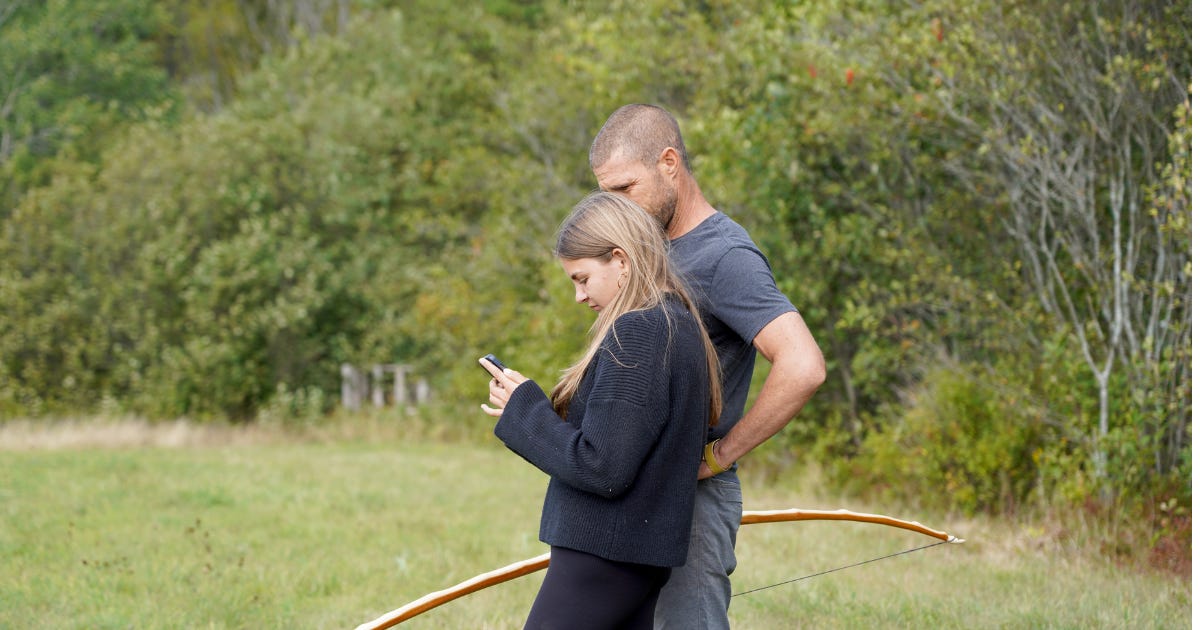
In the process of creating the book, Quiver, Ela and I spent nearly two years researching, travelling, carving, photographing, and writing, all things that brought us tremendous joy, especially since we got to do them together. In the process, we met dozens of bowyers, and with a select bunch - 14 of the world’s finest - we visited each of them, forging friendships and carving a bow. So now we have a quiver of 14 remarkable bows from eight different wood types and a variety of styles that we hope to soon convert into a travelling museum exhibition - a dream for another story. This story is about the dream that has already come true: bringing to the world a unique and shockingly beautiful tome, Quiver, that captures the lives and craft of torchbearers of primitive bowcraft. While I have shared the genesis of this venture, which we dubbed Project Quiver, in the introduction to the book and during many interviews, I will briefly share it again here to offer a glimpse into this platform’s creation myth.

In January 2020, while most of the world was being thrust into isolation, an extraordinary wolf known as Takaya, consciously left his. Eight years prior he had journeyed more than 50 kilometers through a densely populated section of southern Vancouver Island; surreptitiously navigated the streets of the capital city of British Columbia, Victoria; jumped into the frigid waters of the Salish Sea; and swam more than three kilometers through open water to arrive at a small and uninhabited archipelago known as Discovery Islands. Coincidentally, the last person to have ever lived on the archipelago was my friend Joan Morris, who I interviewed in episode 18 of the Salish Wolf Podcast, and who was forced by the government to leave her island home more than 60 years ago.
For nearly eight years, Takaya thrived on the archipelago, swimming between islands or crossing via exposed land bridges at low tide. His diet was mostly seafood, bird eggs, and seals, and he had clearly discovered a year-round source of fresh water. Takaya left his home, the smallest home territory of any wolf in the world, in late January 2020 and swam back to Vancouver Island. We will never know why but perhaps to find a mate. He was first seen in a neighborhood directly behind the famous Parliament building near Victoria’s Inner Harbour,, which is not a safe place for a wolf. He was soon tracked, tranquilized, relocated to a remote forest along the island’s southwest coast, and not long after shot dead by a hunter, sending tens of thousands of people who knew Takaya into mourning. I had hoped to soon paddle my paddleboard to Discovery Islands for the chance to see Takaya in his naturalized habitat, but I missed my opportunity, and grieved his senseless loss with so many others. Yet in his death, Takaya continues to inspire, his legacy spawning a movie, books, events, and the Salish Wolf Podcast. For the first season of the podcast, 50 episodes over the course of a couple years, I shared stories of uncommon people doing extraordinary things.
For various reasons that led to a personal life transformation, I stepped away from the podcast entirely save for three episodes until 2025, when I returned to it for the second season, known as Project Quiver. I was still interested in sharing stories of “lone wolf” types, but the common thread connecting all of them is primitive bow carving. By the time I published the first episode of season two, Ela and I were already deep into our research and planning of Project Quiver, and the podcast was to play an important role. Our concept was clear: travel the world to interview and carve bows with the world’s finest bowyers and capture their legacy in the most beautiful book of primitive bowcraft ever created. All the details in between were a bit more muddled, but we knew in the haze that an epic father-daughter journey awaited.
While I did podcast interviews with the bowyers of Project Quiver, I also interviewed dozens of others and intend to continue doing so. With each interview I become more enlivened by the world of primitive archery and simultaneously more disheartened that I could not have included all of them in the book, not yet anyway. Thus emerged the idea for the “Bowyers’ Dispatch,” a media production of a lesser scale than Quiver but one that would nonetheless provide acknowledgement and a platform for other bowyers. My earliest iterations were of a quarterly magazine, but the world of print publication and distribution is complicated and costly. Then, during the same week, both my wife and publicist separately introduced me to Substack, the latter to invite me to contribute an article for an influential parenting account. I first checked out the account, then the platform as a whole, and finally wrote an article. In the process, my concept for the “Bowyers’ Dispatch” evolved, growing away from print media and toward digital media. Alongside this development, like dormant seeds shooting through fertile soil, arose some old interests, heavily inspired by the subtitle of Quiver: The Art of Life though Bowcraft. It is the art of life that fascinates me, and by which I mean the way that certain people thrive by carving a small niche and pouring into it fervent passion. Not wanting to be limited to telling only stories of bowyers carving extraordinary lives, I plan to again share stories of all sorts of people living fully through a multitude of passionate pursuits, even the ones where they gladly toil all alone. This brought me back full circle to the lone wolf Takaya and the origin of the Salish Wolf Podcast.
When it came time to set up my Substack less than two weeks after first exploring the platform, no handle other than Salish Wolf made sense. This is a platform for uncommon people doing extraordinary things, where you can find articles and podcasts on both the “Bowyers’ Dispatch” and the “Art of Life”. Instead of serving as a space for only my own rantings and musings, I want this to be a community where you can share your own stories, recommend guests and topics, and connect with others who are determined to live their best lives through passionate pursuits, be it bowcraft or any other craft. And if your passion happens to be bowcraft, the “Bowyers’ Dispatch” is where you will be able to find and share all sorts of historical, technical, and personal stories, delving deeply into the craft that has helped shape humanity like no other.
I am honored to have you here. Welcome to Salish Wolf.