

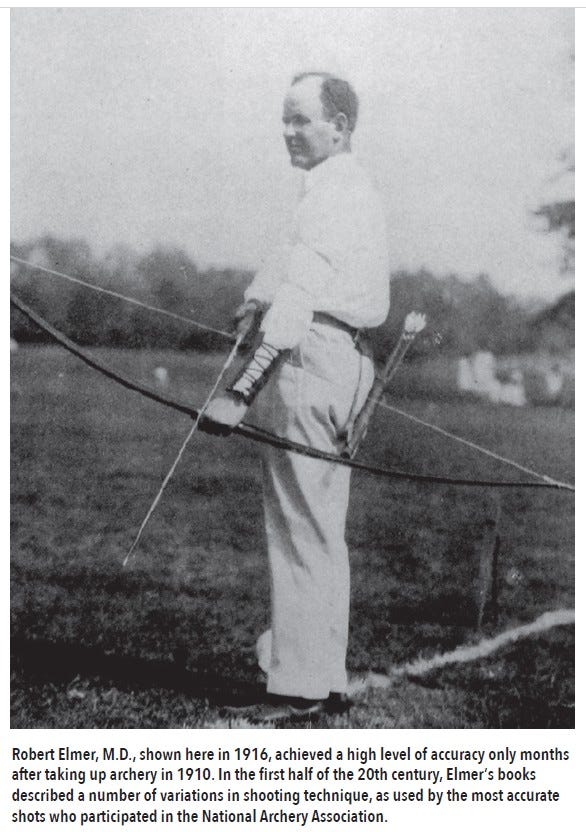
Repeatedly in these articles, I have mentioned the early 20th century archery writer Robert Elmer.
Now it’s time to tell how he learned to shoot a bow and arrow.
Born in 1877, Elmer was a young guy in the early 20th century when a loaded coal wagon ran over one of his feet. His foot never completely recovered.
By 1910, he was looking for some type of exercise that would accommodate his disability and his schedule as a medical doctor. That summer, he purchased some archery tackle.
He learned fast.
That same fall he shot a practice score of 222 (with 30 of 30 hits) on a regulation target at 50 yards. Saxton Pope wrote more than a decade later that the mighty Art Young scored only 198 at the same distance in his best performance.
We might think Elmer lied about that score, but the next year he outshot everyone who shot the Double American Round at the 1911 U.S. National Archery Association’s national tournament. He eventually shot the best U.S. Double American score in 10 separate years, and did the same with the Double York Round in six separate years.
Another fellow worth mentioning is Ralph Miller Jr. In 1933 he shot the best Double York score in the U.S. and repeated that performance with a new world record in 1934.
Miller literally came out of nowhere to score his 1933 win, because he was a 17-year-old high school student who had been shooting less than a year.
How did those guys get so good so fast?
Because of the U.S. National Archery Association, or at least the men and women who were its members.
More than just an organization that staged competitions, the NAA was - particularly from about 1900 to 1941 - a network of the most accurate shots with wooden longbows in the U.S. Until 1934, it was the only national U.S. archery organization. As I wrote before, the NAA’s great value was that of a living laboratory, where shooting techniques were honed and refined by those whose talent focused on making an arrow flying straight to where it was aimed. (They added considerably to the methods inherited from the British.)
Straight arrow flight is still a challenge for anyone aspiring to use the same primitive tackle.
Just as significant, those techniques also were taught to those lucky enough to participate with a number of NAA member clubs spread around the U.S.
SAVING U.S. ARCHERY
The NAA was formed in 1879, on the heels of Maurice Thompson’s book The Witchery of Archery. It is well known that an explosion of archery interest followed that book. Two vital details, however, are usually forgotten. Robert Elmer told about them in his 1946 book Target Archery.
The first is that Thompson’s book did not spark an immediate upsurge in bowhunting. Instead, virtually all the new archers participated in target archery.
The second is America’s new infatuation with archery did not last. While at one time, Elmer wrote, almost every decent-sized town in the U.S. had an archery club, but archery fell out of fashion by 1900. Elmer said this happened in part because bicycling, tennis, golf and baseball were growing increasingly popular. And they were easier than archery.
Archery, he added, “discourages many who lack the persistence necessary.”
At about the time Elmer started shooting, he wrote, the entire U.S. probably had fewer than 300 archers. Evidence suggests most of them belonged to the NAA, and knew how to shoot.
In other words, the only thing at that time that was going to keep archery alive in America was the members of the NAA. And - because those archers who couldn’t get it together weren’t shooting by 1910 - the accurate shots were the ones who were left.
In 1910, Elmer wrote a letter to one of them, Dr. Robert Weston, who shot in the first-ever NAA tournament in 1879 and had been NAA president. Weston wrote back, and told Elmer enough to quickly propel him from rank novice to accurate shot.
Weston’s advice of 1910 was not the last word on the subject. In coming years, U.S. archery techniques continued to be refined and fine-tuned. Which wouldn’t mean much to us today if some folks at the time, like Elmer himself, weren’t writing it down.
Here I’m going to take a look at what was written down, and make a deduction or two about some things that either were not, or were written poorly.
A BUNCH OF REALITY CHECKS
Some people think in terms of absolutes. They demand a single set of instructions that will guarantee good results.
The assumption is that such instructions will not only guarantee good results, but good and fast results. Almost immediate.
It would be my first choice that everybody is that fortunate. But I have seen nothing, ever, that guarantees fast success for everybody. We have to work and experiment with dogged persistence. The ability to shoot almost daily will be our friend in the journey.
“Just do this” shooting solutions were offered, as I’ve said, by pre-1950 archery books designed for children, college students and Boy Scouts. Chester Seay offered a complete system in 1930 with Shooting the Longbow - Relaxed Method, which I described in detail earlier. Stanley Spencer did the same with The Spencer System of Shooting The Bow in 1933.
But other writers of the wooden bow era warn us that no one ever found a “just do this” method that worked great for absolutely everybody. Which we’ll look at in detail. This second group of writers seemed to suggest we should learn to think analytically about our shooting.
If so, it’s good advice. I made that basic point at the beginning of The Bent Stick - the book is designed to help the reader become a bowyer capable of solving problems, of which there is never a shortage.
Yet, if we decide to just “do what comes naturally,” we stand a chance if we’re as bright as the young Owen Hertig.
The 1917 book American Archery (which Elmer contributed to and edited) tells Hertig’s story. In the late 1800s, starting at age 12, Hertig made his own archery tackle and started shooting. He fashioned iron tips onto unfletched hickory shafts and used the primary (pinch) hold on the string.
With this rig, he wrote, he hit a 4x6 inch can 10 times in a row at 20 yards, shot an arrow through a 1-inch hole 18 feet away 35 times in a row, hit a pie pan thrown in the air 100 times in a row 20 feet away, etc. Hertig didn’t elaborate on exactly how he accomplished this stuff, but he stands as an example that anything is possible and there are no absolutes.
It has been said that shooting a bow involves muscles working together in a particular combination that is found in no other physical activity.
It also could be that some people are just born with a natural proficiency for archery, thanks to an exceptional level of coordination for that particular combination.
I am coordinated enough at a number of physical activities, but I have no natural talent for shooting a bow. Any ability I have came the hard way. It can be said that the tenets of NAA shooting were designed to compensate for any lack of natural proficiency.
If anybody today has a high level of coordination that allows him or her to match the accuracy of the young Owen Hertig, by all means keep doing what you are doing! And don’t worry about what I say or what the NAA said.
By 1913, Hertig was competing in the NAA and using the same basic methods as everybody else.
It is not my goal to convince everyone to adopt the NAA methods.
Everybody today can do whatever they want; it’s none of my business.
It also is not my goal to praise the way NAA archers aimed, or even to discuss it.
I am writing about them because they were so good at getting arrows to fly straight with no center-shot, and no deep cut for the arrow (even if not perfectly center-shot) in the side of the bow. Mainstream archers didn’t use those aids before World War II.
Why?
Because until America’s entry in World War II, the average archer had never laid eyes on such things. Until then, center-shot was in an experimental, and very much unsuccessful, stage with very, very few people paying any attention.
THE ARROW PASS: 1926 vs. 2026
The laws of physics force us to discuss this topic if we are to have a realistic understanding of the shooting characteristics of wooden bows made until 1941 (at least) when compared to bows more common in 2026.
The discussion has nothing to do with any sense of superiority or accusations about what anyone might be doing or not doing.
Everything I have seen over the decades points to three conclusions.
One – Those who shoot modern fiberglass-laminated bows do not need to know anything about how the NAA archers shot. That’s not because of fiberglass. It’s because modern manufactured bows use an arrow shelf, virtually exclusively. Some of those bows are center-shot and some are not perfectly center-shot. Learning accuracy with them takes time. But thousands of archers have figured out how to do it. Including me, long ago. It takes persistence, but it can be done. YouTube shows that different archers can do different things with these bows and get good results. These bows are highly tolerant of different techniques.
Two – Those bows with an arrow shelf (center-shot or not) are easier to shoot accurately than an all-wood bow that is wide at the arrow pass, with no arrow shelf. It’s the arrow shelf that makes accuracy easier. It’s the absence of a shelf (even if an arrow rest is glued on the side of the bow) that makes accuracy more challenging.
The farther away the arrow is from the centerline of the bow, the more difficult things get.
To put it another way, it is far easier to become accurate with a bow that uses an arrow shelf. To put it yet another way, accuracy will come easier and quicker, compared to using a bow with no shelf at all. Shelf bows are more forgiving, statistically speaking.
It is often assumed that a bow with a deep arrow shelf cut into the side of the bow (when not center-shot) will behave exactly like an all-wood bow with a wide arrow pass – whether the all-wood bow has an arrow rest glued on the side or not.
I purchased a fiberglass laminated non-center-shot bow, with an arrow shelf, to test the idea.
They are not the same. Being closer to center-shot makes things easier when compared to a wide arrow pass that is farther away from center-shot. The modern shelf bow is typically 3/8 of an inch closer to center-shot than a typical all-wood bow with a wide arrow pass.
And what exactly do I mean when I say “easier”? Those easier shelf bows are far more tolerant of differences in shooting technique, when compared to an all-wood bow with a wide arrow pass. And what do I mean by “wide arrows pass”? The arrow pass is the same full width as the handle beneath it.
Those who doubt this can try a simple test. Find something, like a small piece of wood, about 3/8 inch thick and ¾ inch tall, and tape it onto the arrow shelf of the non-center-shot bow. Shoot it with the arrow outside that block, and see what we get.
At least a few who routinely use shelf bows (center-shot or not) will still get accurate shooting with a wide arrow pass like that used before 1941. This can happen because their method of shooting allows good fortune to smile on them. But such a happy outcome is far, far from guaranteed, or even likely. The adventurous can do the same test with a center-shot bow.
Everyone might not be aware of a third detail.
Bows with no shelf at all have been around for thousands of years. Shelf bows have been around for less than 80 years.
It might be a surprise, but it is true that a deep cut into the bow at the arrow pass (even with no center-shot) – so common in 21st century fiberglass laminated longbows – was unheard of in the golden era of the wooden bow until 1941.
Illustrations in archery books written up to and including the 1930s make that clear.
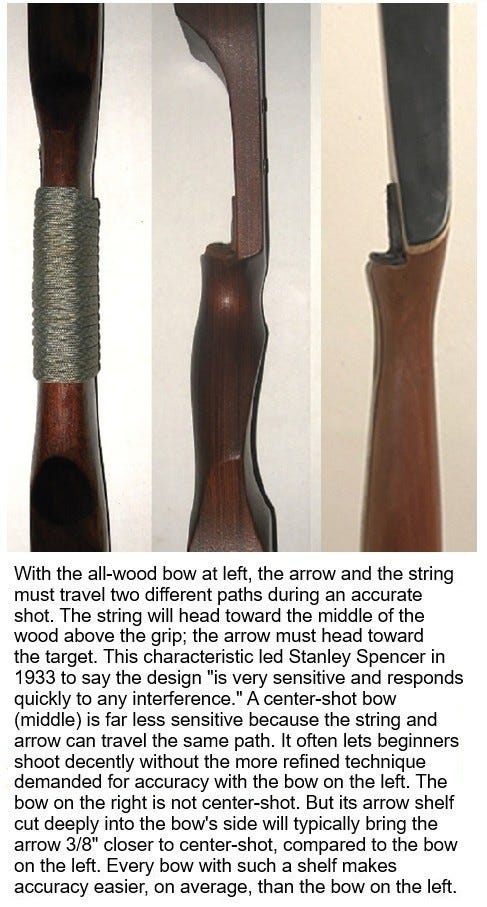
Until about the mid-1930s, US archers universally shot with the arrow resting on the bow hand. It was not until the mid-1930s that archers even began to fasten a leather or wooden arrow rest on the wide arrow pass. And such an arrow rest does not equal an arrow shelf. Not by a long shot.
On YouTube, evidence appears that backs up shelf bows’ ease of shooting.
It is possible to find archers on YouTube who shoot shelf bows, whether center-shot or not, with impressively consistent accuracy. From what I see, archers shooting center-shot shelf bows can transition to non-center-shelf bows with relative ease, even if it requires some adjustments.
And a good percentage of those archers use a long hold at anchor of a full second or more.
That kind of technique is rarely seen among archers using all-wood bows with no shelf at all. With those bows, nearly all archers tend to release while the drawing hand is moving backward, or almost immediately when touching the anchor point.
In fact, old books such as Toxophilus, written in the year 1545, often say a long hold will spoil the shot.
The use of synthetics like fiberglass did not exist in U.S. archery before the country entered World War II.
The war greatly accelerated fiberglass technology, and use of fiberglass in bows exploded in the 1950s.
It took the development of fiberglass in archery bows to make center-shot and the use of a deep arrow shelf cut into the side of the bow (even if not center-shot) viable propositions for mass production.
We must not forget what Robert Elmer wrote – that hundreds and probably thousands of aspiring archers gave up and quit before 1900 because accuracy was very, very difficult with those all-wood bows with a wide arrow pass.
It is central to this topic that in the 21st century, some people are cutting a deep arrow shelf into the sides of an all-wood bow.
Some are even making all-wood bows with a handle section wide enough and deep enough to make the arrow shelf center-shot.
Others understand what bows up to the 1920s and 1930s were actually like, and are determined to limit themselves to the type of designs used in that era.
To put it another way, whatever the archers of the ‘20s and ‘30s had to do to become good shots, we are willing to do. Whatever they had to learn, we are willing to learn. No matter how long it takes. And we won’t be discouraged by the “persistence necessary” that Elmer cited. This attitude was universal among prominent makers of all-wood bows that I knew in the 1990s.
KILLING IT IN 1933
Let’s also remember that in 1933, Spencer said good target shots easily could be good bowhunters. He should know - his mentor was “Chief” Will Compton, hunting companion to Saxton Pope and Art Young.
Another question is just how good were the best of the old-timers with wooden bows? Plenty were hell on wheels at short range.
It’s also true that as great as they were, they couldn’t work miracles. Plenty of past champions would from time to time miss a 4-foot target at 80 or 100 yards. While Art Young was a demon at hitting a fist-sized target at 20 yards, Saxton Pope wrote that at the height of his powers Young could hit a 9-inch ring only 17 out of 30 shots at 40 yards.
Let’s also remember that any traditional barebow shooting is a challenge. The World Archery Federation sanctions indoor barebow events (with center-shot recurves) at 18 meters at a 40-cm target of five colors. The gold part in the middle is 8 cm (3.15 inches) wide. I often watch these competitions on YouTube. These people have every 21st century technological advantage. They use proven aiming techniques and are among the best. And it’s very difficult, and rare, for them to put every single arrow in that 3-inch gold center at 18 meters.
‘THE WATCHFUL ENEMY’
Stanley Spencer laid out the consequences of non-center-shot concisely in his book: The wooden bow of 1933 “is very sensitive and responds quickly to any interference.” He meant a bad response, of course, displayed by arrows landing all over creation.
In Great Britain’s Badminton Library of Sports and Pastimes 1894 volume on archery, Rev. Eyre W. Hussey wrote that the all-wood longbow is “a watchful enemy, ready to take advantage of the smallest slight” to create “a compendium of concentrated cussedness.”
These conclusions are accurate. All-wood bows with a wide arrow pass can be as vexing in the 21st century as they were in 1894.
The larger question is this: What exactly IS a reliable technique for an all-wood bow of ancient design, with a wide arrow pass?
The members of the NAA, and the British before them, had some definite and often different ideas about this, proven by experience.
And history shows that those who watched such archers in action, and/or listened to them, could duplicate that success.
If that tiny group of NAA members had an unwritten charge in 1910, it was to rebuild a U.S. archery scene that could command those “very sensitive” bows.
AN ISSUE OF MANAGEMENT
Eyre Hussey wrote that some archers couldn’t adopt the prescribed stance of standing sideways to the target, because their bellies didn’t give them enough room to draw the string that way. They couldn’t manage it, in other words.
In his books of 1926 and 1946, Elmer described differences in the techniques of the best shots he knew.
Arthur Lambert Jr. made a similar effort in his 1929 book Modern Archery, but not quite as extensively as Elmer.
These differences were in the way skilled archers drew their bows, held the bow in one hand, held the string in another, released the arrow, etc.
Slight physical differences among individuals (to say nothing of differences in mental and emotional disposition) probably explain this. Elmer presented variations in technique with the tacit implication it’s our job to find those that work. The coaches of the NAA are long gone. If we’re forced to figure it all out on our own, the challenge is daunting. Almost a nightmare, one might say. But it’s not impossible.
WHAT BEGINNERS LEARN
Throughout the ages, countless users of bows with no center-shot and no arrow shelf soon learned that if they wanted to make an accurate shot, they had to release while the arrow was being drawn, or almost immediately when stopping the draw.
In other words, if they paused and held the draw too long, they couldn’t make an accurate shot.
This idea persisted into English language archery literature.
In 1856, Horace Ford wrote that he completely agreed with what Roger Ascham wrote in Toxophilus in 1545: “Holding must not be long, for it ... spoils the shot.”
Maurice and Will Thompson agreed when they wrote How to Train in Archery in 1879: “Hesitation at the point of loosing (releasing) will destroy the alignment of a shot.”
WHAT THE NAA ARCHERS DID
By the 1930s, many archers who belonged to the NAA learned how to draw and hold for a full second, and often longer, without spoiling the shot. Take plenty of time, Stanley Spencer wrote. This approach, in fact, made them more accurate, not less accurate. Because just before the release, the aim was as steady as a rock.
Elmer said this approach allowed aim corrections after anchoring. This was done, he said, with movements at the waist.
I repeat: All evidence suggests those NAA methods are not needed for shelf bows. We’re talking about all-wood bows as used in the 1930s and before.
To understand how they did it in the 1930s, we have to re-engineer a typical NAA style shot. Instead of working from the shot’s beginning to end, we will work backward - from its end to its beginning.
THE ARROW LEAVES THE BOW
I will state this more directly than probably any vintage archery book did, because the wooden bow era was nearing an end before Archery: The Technical Side underscored this in 1947.
When the arrow is leaving the string and is passing by the 1930s bow, the bow must make at least a slight movement to the right for a right hand shooter. This is vital to allowing the arrow to fly straight, instead of wide to the left for a right-handed shooter. The Technical Side used slow-motion film to document this in an accurate shot. (Keep in mind we are talking about consistently precise shots throughout this, and not “OK” or sometimes precise shots.) As the limbs begin to move, the bow makes a tiny movement backward (from the recoil of the limbs) before it moves forward and away from the arrow.
Years before The Technical Side, Elmer demonstrated that movement is a reality. He did it by bracing the right side of his bow hand against a tree. The arrow flew wide to the left.
While all arrows flex when shot, these findings prove an accurate arrow is not going to bend completely around a bow with a wide arrow pass.
In his 1946 book, Elmer wrote, “Arrows that correct the entire paradox by themselves are too limp for accuracy” - a fact demonstrated by a shooting machine that did not allow the bow to move to the right.
Those who doubt this are invited to recreate Elmer’s experiment with a tree.
That slight movement only needs a brief instant to take place.
Before 1941, it was accepted that a bow would make at least a small forward movement during the shot, which The Technical Side confirmed.
Some writers - like Chester Seay, as described earlier - advocated making that forward motion intentional, and even exaggerated. Some called the movement the “bow arm release.”
A big detail in this is the fact a 28-inch arrow, if launched at a modest 150 feet a second, needs only 0.015 second for the nock to be in front of the bow. If we are making an intentional move, much of it in reality is follow-through. How much follow-through we might need is a management issue. If we need it, we need it.
The bow arm release is the last thing that happens. It played a recognized role in 1930s accuracy, and likely helped those archers to use a longer hold. It also was (and often still is) displayed in precise shots who don’t use a long hold.
Arthur Lambert Jr. was a pioneer in describing a bow arm release in 1929’s Modern Archery. He wrote that he would hold until he was good and ready to shoot. Then he said he “handed” the bow during the release. He described this as an action of the wrist, as if he was giving an upright tennis racket a small flick forward. If exaggerated, the upper limb can be seen to tip forward during the shot, moving more than the handle itself.
Lambert wrote that the move brought all arrows closer to the center of the target, even if the arrow spine was less than optimum. That’s a bold statement, but all evidence I have found confirms that potential is there.
It’s just a question of management. What do we have to do to make it work? As I wrote earlier, Chester Seay had a different idea, quite famous in 1930, that I described in detail in the last article. He separated the bow hand and drawing hand vigorously at the release. Stanley Spencer said the bow arm release happens automatically if we allow the bow to settle itself into the hand during the draw, with the arm “leaning” on the bow and the bow hand’s fingers only lightly touching the forward side of the grip. Gilman Keasey said the arm and shoulder muscles should keep pushing the bow during the shot, and the fingers should grip the handle very lightly.
Seay, Spencer and Keasey all used a slightly bent elbow with the bow arm. Robert Elmer wrote that he used an extended bow arm with a locked elbow because it provided a solid launching platform for the arrow. He also used a loose grip. This would have allowed the bow to move to the right (for him) that small amount on its own.
We must pause here to listen to what Elmer said specifically about using the fully extended and locked bow arm.
He said the best plan is to fully extend and lock the bow arm before even raising the bow. The bow arm is then raised in that position like the handle of a water pump when we level off at the target. (We can google it if we don’t know how old time water pumps worked.)
While he didn’t say it directly, his implication is clear. If we wait until we have reached full draw, it is too late to think about extending and locking the arm. In other words, the advantage is lost if we wait that long.
At the least, we need to fully extend and lock the bow arm when we level off on the target. What is vital is that our bow arm be in that position when we complete the last six or more inches of the draw.
If it needs to be said, locking the arm in advance means the bow arm is taken care of and if we can keep it that way, we don’t have to think about it anymore. Instead, we can focus on the anchor, the aim and the release.
Those who use an intentional bow arm release (pushing the bow forward during the release) with a bent elbow need to be good at it. It could be a test of athletic ability to get it to work consistently. Evidence suggests it’s a test not everyone can pass.
The risk is that an intentional forward move will be slightly sideways as the arrow heads out. The arrow will fly off to one side if that happens. Seay, as I wrote earlier, devised a training program to help archers master the move.
By 1946, Elmer wrote about pushing the bow forward during the release. He said this could be tricky. It certainly can be.
It might be less tricky if the archer uses Elmer’s extended arm and locked elbow. In such a position, the bow arm can move forward, but only slightly. That could greatly reduce the risk that the forward motion will turn into a sideways motion that can spoil the shot.
THE STRING LEAVES THE FINGERS
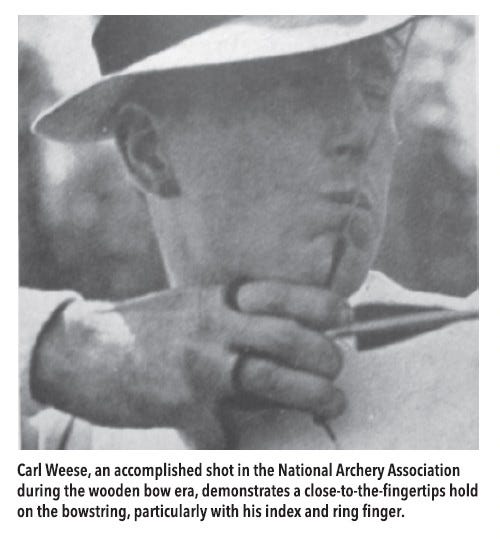
Most literature from the wooden bow era advises drawing the bow with the string as close to the fingertips as can be managed. This usually was close to the crease of the fingers’ first joints, on the side closest to the fingertips. To accomplish this, the fingers are as straight as we can get them while pulling the string. The goal is to avoid unwanted disturbance of the string (sideways movement, for example) as it leaves the fingers. The result, Lambert wrote, was a clean release with little finger movement.
But, as Seay and Spencer wrote, a backward movement of the drawing hand is good insurance for (or good evidence of) a clean release. As with the bow arm release, the drawing hand movement faces the same possibilities: Unintentional, intentional, small movement or exaggerated movement - all because of management issues.
A common move of the 1930s was to straighten the fingers slightly during the draw to position the string closer to the fingertips. Others, no doubt, began the draw with string close to the tips. Elmer wrote that some archers hooked their fingers more deeply on the bowstring.
Regardless of how they held the string, a number of the best NAA archers favored a small plucking movement straight backward during the release. Others, like Art Young, used an exaggerated backward yank, with the movement centered in the shoulder.
By comparison, both Spencer and Keasey said to relax the fingers while increasing the pressure of the backward pull. No pluck or yank, in other words.
Spencer wrote the thing to do was bend only the first joints of the fingers, close to the fingertips, while the fingers elsewhere are perfectly straight. A surprising idea, since my hand can’t do that and I’m not sure I know anyone who can.
During the draw, many writers said, the thing to do was either keep the drawing wrist straight, or relaxed so it could be aligned by the tension of drawing.
REACHING THE ANCHOR
I hope everybody reading this knows what an anchor point is. It’s touching the drawing hand to the same spot on the face. One goal is drawing the arrow the same distance during every shot. Touching the index or ring finger to the corner of the mouth, for example, is a common way to do it.
A long time ago I had the idea to just pick the same anchor point as everybody else and make it work.
When I talked in 1991 to Gilman Keasey (two-time world record holder in the Double York Round in 1935 and 1936), he told me that might be a bad idea. Responding to my annoying questions, he suggested each individual will have an anchor point that will work better than any other, and it might not exactly match what others do. It’s our job to find it.
I’m not sure shelf bows are so fussy. Keasey’s advice is yet another indication that shelf bows have more tolerance for varied technique than an all-wood bow with a wide arrow pass.
Keasey clearly knew something about how to anchor, because he told me he used not one, but two anchor points in the 1930s. One was low for long range and the other higher for short range. Not once in the historic literature have I found anyone else saying they did such a thing with such success.
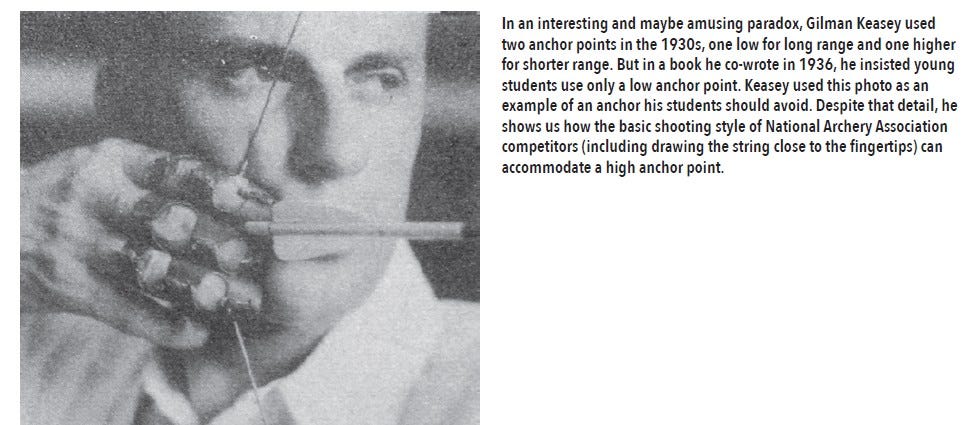
He also said the anchor point will depend greatly on the stance. Both must be consistent, he said. The implication, he said, is that when the anchor and stance are really working together correctly, the arrow is aligned with the eye (right eye for shooting right-handed) as soon as we anchor.
That would mean that the arrow is automatically pointing at what we are looking at (at least in terms of the correct line, not too far to the left or right), without any advance squinting or squirming to line things up. I was practically stunned when that idea sank in, but it certainly helps explain why Keasey and people like Elmer and Miller could do what they did. To be fair to the rest of us, it has to rank as an advanced skill when done correctly, and those guys were advanced.
Many of us who grew up with fiberglass and shelf bows got into the habit of hooking the string deeply with our fingers, in part so we had enough finger protruding to use one to touch the anchor point.
If we use the near-the-tips, straight finger hold advocated before 1941, the firm finger on the anchor point might not be so easy. Some deal with this by anchoring as best they can, or protruding the lips so a finger can touch them, etc. Any of which could work.
Yet, it is a fact that among 13 different books written when all-wood bows were the only type available, not one of those books says to anchor with a fingertip. Stanley Spencer, in fact, said to never anchor with a fingertip.
Because almost all of them anchored below their chin for long-range target shooting, they typically positioned the top side of the finger under the chin.
Spencer made an interesting point about this. In using the anchor, he wrote, “always use some part of the base, or heel, of the hand to locate it by, and never by the ends of the fingers.” His point was the fingers had more important work to do on the release.
Arthur Lambert told how other folks did it. Some used the top or side of the index finger, or the point where the index finger meets the rest of the hand. The side of the thumb tip is another possibility, if we can keep the thumb straight and close to the rest of the hand.
We today who shoot by tilting our head to one side might say this is crazy and can’t be done. Point taken; we’ll get to it in a minute.
For the benefit of we who grew up on fiberglass, it should be pointed out that among the old NAA shooters, a high anchor like that used for hunting (compared to anchoring under the chin, common in the NAA for long shots) was no big deal - it easily could be integrated into everything else they did. So said Robert Elmer, who wrote that some NAA shooters used such an anchor all the time, particularly in the early 1900s.
For shelf bow shooters, a very common anchor in the 20th century was the middle finger on or close to the corner of the mouth.
In the 21st century, YouTube shows that a number of very proficient shelf bow shooters anchor considerably higher than that, putting the arrow nock as close to the eye as they can manage. This idea has merit, because if the arrow nock is too far to the left or right (which means the arrow would be pointed too far to the left or right) the close-to-the-eye anchor makes it much easier to spot the error, when compared to a lower anchor.
Today’s shooters might congratulate themselves on this innovation. But Elmer describes it in the 1933 reprint of his book Archery.
He describes it as drawing almost up to the eye, and said it is advantageous to what he called almost flat trajectory shooting. The distinction being that shooting at 40 yards to 100 yards (distances in NAA competition for men) is far from a flat trajectory.
He further wrote that almost flat trajectory shooting would include shooting at squirrels in trees. Which, we can infer, would make this flat trajectory shooting effective up to about 20 yards.
DRAWING THE BOW
By doing lots of searching online, I have found vintage movies of good archers drawing and shooting in the era when shooting wooden bows with the arrow resting on the hand was the only available option.
And if I play those movies at slow motion, the archers all have one thing in common. However far they extend their bow arm, the bow arm is extended to that point before they anchor.
That does not mean, however, that the string is not pulled back at all until the bow arm is extended.
Typically, the string has been drawn at least a few inches before the bow arm is even raised to the correct elevation.
These are points to keep in mind when we read what the old books say about the draw.
Perhaps today’s most widely used and recognized draw was described by Horace Ford in 1856. He wrote, “Make the pulling of the bow and the extension of the left arm a simultaneous movement, and to such an extent, that the arrow shall be at the least three-fourths drawn at the time it is brought upon the aim” - which is to say pointed at the target. From there, the drawing hand comes straight back to the anchor.
Ford said this movement could happen as the bow was being raised or lowered to point at the mark. On probably any given day before 1945, NAA archers could be found doing it either way.
I have seen an old piece of unnarrated newsreel that I’m positive shows 1930s NAA ace Russ Hoogerhyde shooting a few trick shots. He follows Ford’s advice, but on a couple of shots he pauses a fraction of a second after the bow is raised and before he draws straight back. Not a bad idea if we want to increase the steadiness of the process.
Ford might have remembered what Thomas Waring wrote in 1824, also in Britain: “It is the method of our best archers as they raise the bow, to draw it three parts of the way - there pause to take aim - then draw it quite up to the head, and instantly loose.” And that, by the way, isn’t a bad approach for those who find they must release during the draw to shoot straight.
Elmer described other ways of drawing. In one, the archer raised and drew the bow in a single movement, anchoring almost as soon as the bow was raised. Another was Chester Seay’s method - raising the bow to eye level, then pushing the bow forward simultaneous with pulling the string.
When it comes to aiming during the draw in the 1930s, plenty of NAA archers sort of did and sort of didn’t. What they all did do was draw in line with the mark - with the arrow under their right eye (for a right-handed shooter) at least when they began to draw straight to the anchor. Elmer said many kept the arrow under that eye during the entire process, raising the bow vertically from below.
Some, like Hoogerhyde, drew fast and probably weren’t paying a ton of attention to the arrow when they did. Elmer said he drew quickly, to save his strength for the hold and release. This conforms to Keasey’s goal of having the anchor and stance ensure the arrow is perfectly lined up with the eye, virtually automatically.
Another question is whether to draw with a slightly bent elbow of the drawing arm, or to fully extend the arm with a locked elbow. It’s definitely possible an archer can shoot very well with one option, and not so good with the other. It might even be a likely possibility. It’s another discovery we have to make for ourselves.
PREPARING TO DRAW
Judging from the amount of space pre-1950 books spent discussing this stage, it was considered a vital step and for good reasons. Much of what will follow depends on what happens at this time.
Almost all of those books began with the archer’s stance, and I think every U.S. book I’ve read screwed up the description. They all say both feet should be on a line that leads straight to the mark. That the archer is standing sideways to the mark.
That’s not wrong, but it’s not the entire story.
Those U.S. books all failed to point out what Eyre Hussey described clearly in 1894: The object is to have both shoulders form a line that points to the mark. It’s the shoulders that really count, more than the feet. This is an important distinction for hunters, who can’t always place their feet like that. But they can turn at the waist, to put the shoulders in the correct position. If the shoulders aren’t perfectly sideways to the mark to match Hussey’s advice, they are mighty close to it.
If there is one single thing we can remember that will bring the rest of the body into the correct stance, it is this: If we are right handed, the bow arm must be extended out from the left side of the body. If, by comparison, the bow arm is extended more to the right, so that part of the chest is facing the target, we will lose the stability provided by the stance advocated by the NAA.
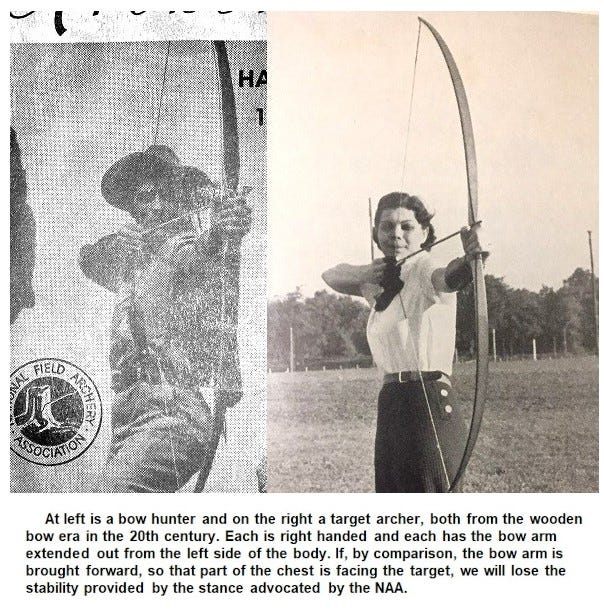
This “out from the left” position is one that need not feel strained. If it is out to the left and all feels fairly comfortable, that’s adequate, and we should find that drawing to anchor also will feel comfortable enough. If by comparison we are using Elmer’s locked arm - and we definitely should try it - that arm will feel extended to its full length.
It’s worth mentioning that the shoulder position typically isn’t considered in the modern era. I suspect that with today’s shelf bows, it might not be that important.
But with an all-wood bow with a wide arrow pass, shooting with the arrow resting on our hand, all evidence is that it is important.
In How to Train in Archery, the Thompson brothers wrote (perhaps surprisingly) that anything less than a sideways stance is a “false position.”
Among other things, the correct stance forces the upper arms to be about as far apart as possible at anchor. And - as anybody who does bend-over rows with dumb-bells in a gym might know - this forces the back muscles to be not just involved, but seriously involved. Before 1941, nobody talked about back tension like they do today. As near as I can tell, the entire concept stemmed from a book on Arab archery Elmer helped translate, and he described it at length in his 1946 book, clearly infatuated with what he’d done.
Before 1941, the back muscles were discussed but it was that out-to-the-left stance that did a lot to ensure by default that those muscles were fully engaged.
The old books also screwed up by repeatedly saying the head should turn to squarely face the mark. I’ve read that the typical human neck can only turn the head 45 degrees left or right from a straight-ahead position. In other words, virtually nobody can turn their head that far to the left (we’re talking about right-handed shooters now; reverse this stuff for left-handed). To aim directly at the mark, we have to look almost out of the corner of our right eye if right handed.
Once that happens, another benefit emerges. Now most of us can anchor directly under our right eye by anchoring on the side of the face, while keeping the head upright. We can anchor high or low. Tilting the head isn’t needed unless, shall we say, the face is more voluminous than normal.
This has multiple advantages which tilting the head might not have for everyone.
It lets us anchor with the heel of the drawing hand, or the thumb, or the top or back of the index finger, like Spencer and Lambert said.
The upright stance also creates the advantage of having no part of our anatomy behind the drawing hand. The NAA style dictates that the drawing hand has to move backward at least a little. The drawing hand needs a clear path behind it.
After 1910 or so, anybody who was anybody in the NAA held the bow perfectly upright or nearly so, almost always less than a 10-degree cant. Anchoring on the side of the face allows this, and it also has automatic advantages built in.
Remember what Keasey said: The anchor point and stance must be consistent. As soon as we learn to stand up, we are trained to recognize vertical and horizontal. The upright head and stance puts everything vertical, and it’s easy for us to recognize what’s exactly vertical and what isn’t. This makes it easier to consistently repeat our movements with precision. Some went so far as to ensure the string was always in the same position in their field of view, compared to the bow, to consistently repeat the bow’s position right down to the last degree.
By comparison, if we cant the bow a lot and tilt the head, we must somehow duplicate the head and cant angle precisely (in number of degrees) each and every time to duplicate what the NAA shooters did. Otherwise, we’ll have to do something to convince ourselves the arrow is lined up with the eye. Like drawing slowly, or studying the arrow’s position a bit before the anchor. This is yet another example of something most shelf bow shooters don’t have to worry about. They can cant the bow as far as they like with no problem.
It’s certainly true that after World War II, the use of a significantly canted bow became widespread. But its adherents, in all likelihood, had no idea what NAA archers did, unless they were avid readers.
We should quote what Robert Elmer said on this subject. He didn’t think canting the bow and tilting the head was such a big deal for bowhunters and those who did most of their shooting close up. Cant the bow, tilt the head, face the mark a bit ... yeah, whatever, he implied. Bowhunters don’t shoot that far away anyhow. They don’t need the level of precision required to hammer the center of a target 100 yards away, he thought. (Hunters using shelf bows, which solve a lot of issues, also deserve an exemption.)
Saxton Pope, Art Young and guys like Pat Chambers (a one-time Double York Round record holder who hunted and could shoot ducks out of the air) did it more like the NAA. Pick your poison.
Another detail to be decided at this stage is how to hold the bow. The most common pre-1950 advice was to use a loose grip and place the bow mostly on the large muscle at the base of the thumb.
In other words, the hand holding the bow was more of a place for the bow to rest, than it was a place where the bow should be gripped.
A grip resembling that used to hold a hammer was sometimes recommended. I’d suggest experimenting with every grip we can think of, and both loose and tight holds. Not just a few times, but repeatedly as we make progress. The wrong grip (for any individual) can make every arrow fly left. Like the anchor, we need to find a good one.
Thomas Waring in 1824 suggested bending the hand holding the bow outward at the wrist, to put the wrist more directly behind the bow. Almost every writer afterward said that was a terrible idea. I’m not so quick to agree with them because I don’t think bending the wrist as far as Waring suggested is always needed. We’ll likely need an armguard close to the wrist if we try it. In fact, we might need an arm guard all the time and plenty of the best old time shots used one.
Plenty of books, old and new, often warn that some particular practice will guarantee failure. Such warnings are often incorrect. The fact is that if we make any error in shooting an all-wood bow with a wide arrow pass, the arrow could end up flying in any bad direction.
As we stand alert, ready to shoot, I’d suggest drawing the string at least a few inches before raising the bow. This bit of starting tension will settle the string onto the fingers. Among other things, it can eliminate the danger of the arrow falling off the hand as we begin to draw.
NAA ARCHERY TACKLE
One thing that helped archers of the NAA achieve a high level of accuracy was the length of their bows.
NAA archers used longbows that were long. A man drawing 28 inches used a 72-inch bow. A woman drawing 26 inches used a 66-inch bow.
These long bows had two main advantages. They were smooth at the end of the draw, meaning the draw weight did not “stack” or accumulate suddenly there. A smooth draw helps maintain mental calm as we concentrate on the anchor and release.
Longer bows also don’t squeeze the drawing fingers together as badly as a short bow. The drawing fingers have to get off the string as quickly and smoothly as possible. They need all the help they can get.
Widths at the pre-1941 arrow pass ranged from 1 1/8-inch for Saxton Pope’s bows to an inch or somewhat less. I have a yew bow Gilman Keasey made that’s 13/16-inch wide at the arrow pass.
An even wider arrow pass is possible on a bow that bends all along its length, like an aboriginal bow. Many have found that such a handle - or the lack of a handle to be precise - can be accommodated by adjusting their grip.
When it comes to arrow spine in the 21st century, 3 Rivers Archery and Kustom King each have a chart online that suggests spines for non-center-shot bows, identified as longbows and self bows. The charts were identical the last time I looked at them.
These charts are a guide for arrow shafts and finished arrows that we buy. So if we’re buying that stuff, the charts are a good place to start.
Yet it almost is a sure thing that the “longbows” described on the charts are shelf bows, even if they aren’t center-shot.
If we shoot an all-wood bow with a wide arrow pass, we might find the arrows listed on the charts are a bit over-spined. There is a fairly easy way to deal with this, but it requires some experimenting on our part.
If we increase the weight of the field tips on the arrows - for example, going from 125 grains to 145 grains - that lowers spine.
If heavier field tips are not available, we can experiment by using longer arrows. If we make longer and shorter arrows of the exact same material, the longer arrows will have a lower spine.
If we make our own arrow shafts from scratch, more experimenting will be required. Based on my experience, making all arrow shafts the same diameter is a big first step in a consistent spine in a group of arrows.
Robert Elmer wrote that before flatbows became widespread, nearly every target bow showed noticeable string follow. If our bow does also, I wouldn’t worry about it one bit in terms of accurate shooting.
When it comes to glove vs. tab, thick vs. thin, I say experiment. I have quite the collection.
Some novices raise the brace height higher and higher, praying it will solve their problems. I’ve explained above how the NAA solved problems. I think 6 inches of air between string and bow is plenty, but if we use a 72-inch bow odds are good the bow can stand a higher brace height.
Shorter bows easily could suffer too much string follow or other damage if we overdo brace height.
In other words, too much brace height might damage a wooden bow.
THE PRICE TO BE PAID
Elmer’s 1946 book has a section on a system developed by Marvin Schmidt (who also wrote his own shooting book) to assess different shooting variables, as used in combination. The idea was that some variables don’t work well together. It’s a case of finding the right combinations. Which adds to the challenge.
I don’t think I ever knew any really good shot who didn’t have the advantage of being able to shoot whenever they felt like it. A lot, in other words. The best scenario is to own a house where we can shoot in our own backyard. Most highly proficient archers I see on YouTube who don’t use compound bows have at least one target in their yard.
If we want to get really good, we have to shoot a lot and put in the time, no matter what style we choose. It might help explain how Owen Hertig got so good. It helps to learn in private. A lot of our experiments will produce awful results.
If we are in urban areas with no backyard, we have to improvise. I have seen indoor ranges in basements, garages, etc. ranging from 4 to 15 yards. Good idea, particularly if we focus on hitting very small marks. It beats the hell out of nothing. I would make a big pile of portable targets to make sure we don’t plow an arrow into a concrete wall or through a window. Anybody doing this in a town should be mighty careful and very discreet. In some cities, shooting a firearm, BB gun, airsoft gun or arrow in city limits is illegal.
(Legal disclaimer for the record: Follow the law.)
And good luck. We always need that.
Paul Comstock is the author of The Bent Stick: Making and Using Wooden Hunting Bows and a co-author of The Traditional Bowyer’s Bibles, Volumes 1–4. He also wrote the Foreword to Quiver: The Art of Life through Bowcraft.